Gallery Paintings: The Self-Aware Art of the 17th Century
How Flemish artists turned paintings inward on themselves in masterpieces of recursion.
The Neues Schloss is a massive structure, a labyrinth of interconnected rooms and chambers. The Baroque palace, now a museum, marks one of three on the sprawling grounds of the Schleissheim complex sitting just outside the urban limits of Munich.
Each chamber in the palace once served a special purpose. But now that the halls are silenced of their princely activities, the walls offer ample space to house the Bavarian State’s significant art collections.
I end my tour of the apartment wing in the Dutch Art Cabinet and adjoining Oratory. The cabinet is filled with paintings by Northern masters of the seventeenth century, many that were specially collected by the Elector, Max Emanuel, during his time as governor of the Spanish Netherlands. I admit, the Italian paintings in the collection don’t hold my interest for long. But the works by the Dutch and Flemish artists, well, these are fresh and interesting. In this gallery, the theme of paintings drift away from dramatic religious iconography and lean into the grounded carousing of daily peasant life in the Netherlands: scenes of ruddy, rounded figures in taverns, drinking, puffing on pipes, brawling, gossiping.
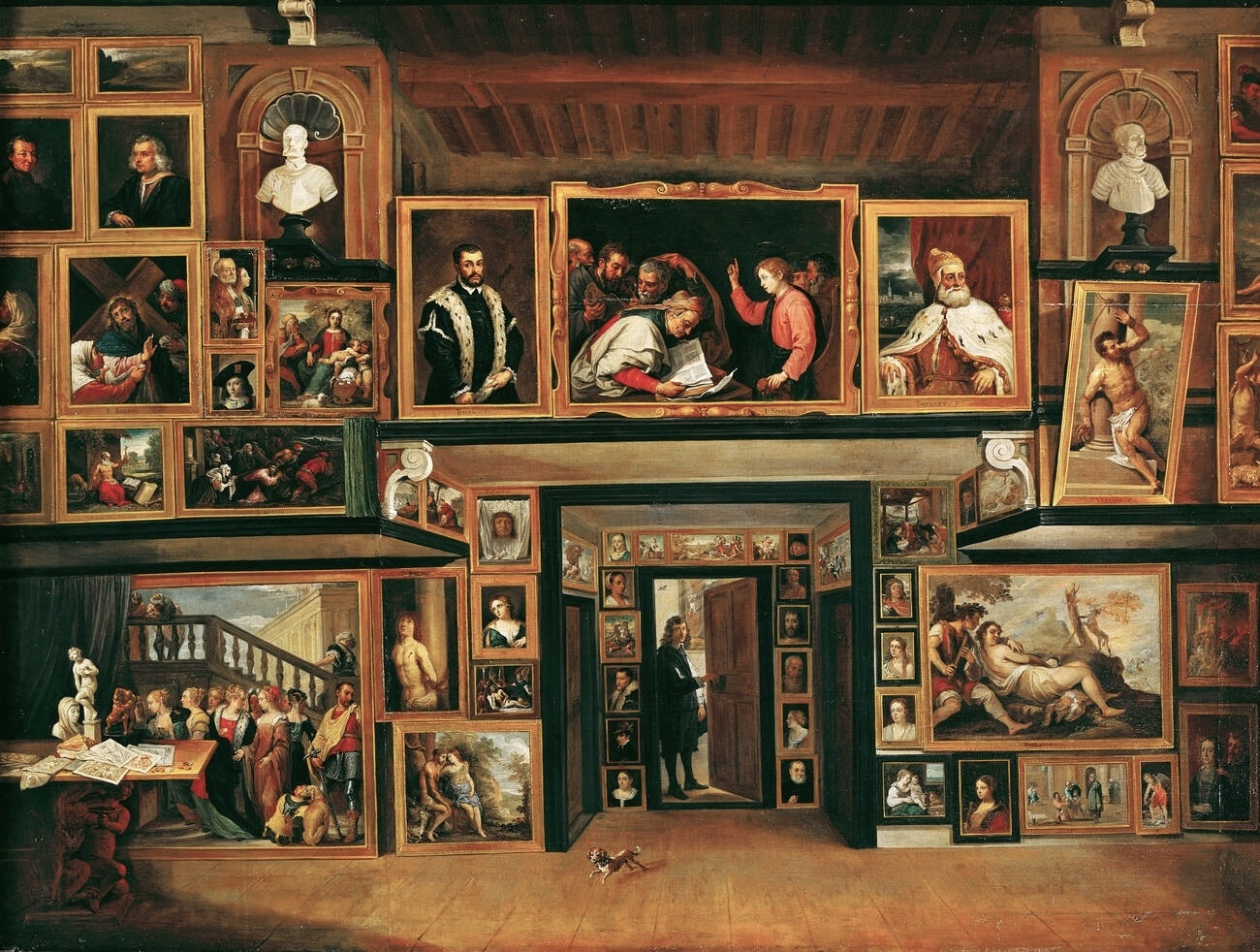
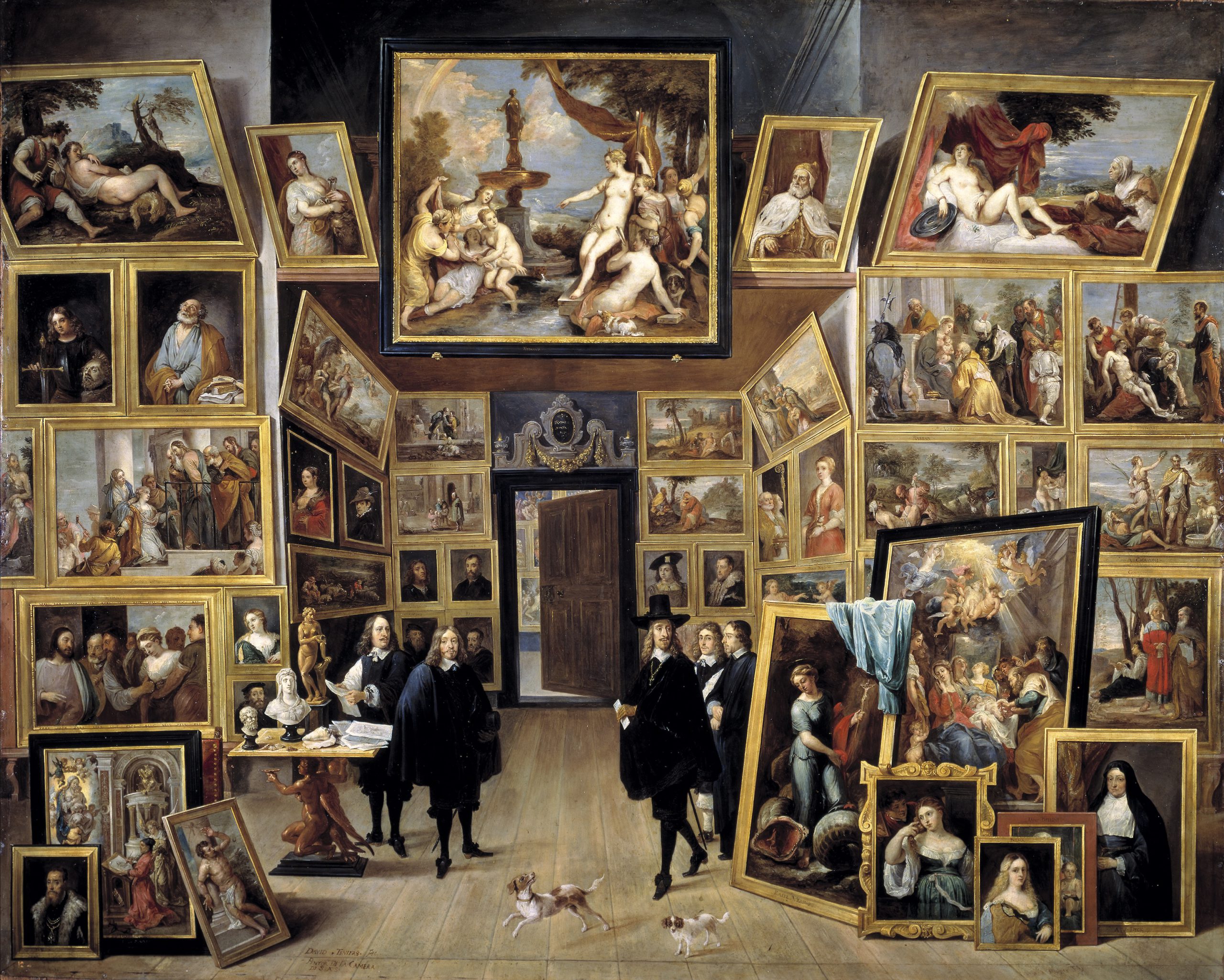
But one unusual piece that’s not like the others catches my eye and draws me in. The painting is of a view into a seventeenth-century art room displaying dozens of paintings from the Italian Renaissance, rendered in miniature, crammed onto walls from floor to ceiling with no space between them.
Leaning in close to take in the details of the smaller paintings, I can see that each one is a tiny, complete masterpiece. The artist also inserted himself into his creation. He is caught stepping through the door of the gallery into another room, looking back at the observer as if to invite them to do the same: to step through the gilt picture frame into the meta world where he lives.
There are more paintings in the cabinet by the same Flemish artist, David Teniers the Younger. Another shows a similar gallery room filled with paintings—some I recognize as repeats from the first, only in different arrangements—on every wall and propped up in every conceivable place. The carefully curated juxtaposition of images is both startling and mesmerizing.
Who was this artist that had the power to capture my attention so keenly, and what was this unique style of meta art that was of art itself?
David Teniers the Younger (1610–1690) was not only one of the most versatile and innovative artists of his era, but he and his contemporaries embraced an art movement that would become synonymous with both a time and place in art history: the seventeenth century in the flourishing artistic epicenter of Antwerp. The art movement was the gallery painting.
The Gallery Painting
In the early seventeenth century, a new type of image began to appear on the art scene, a specialty born within the stone walls of Antwerp’s guild of painters. In these images, the subjects were not landscapes or portraits but the art itself—paintings of smaller paintings, paintings within paintings. It was a form of meta art that directly acknowledged its creation, its manner of display, its very existence.
The notion of the art gallery as a private exhibition space existed long before the first public gallery was ever conceived. By the start of the century, the pastime of curating art for private collections was expanding rapidly across Europe. Those who had the influence and means—the aristocracy and the wealthy elite—amassed vast collections of valuable paintings, sourced from far-flung regions of the continent and from just as diverse artistic traditions. Possessing a significant art collection of rare and coveted works signaled prestige, and was a way of displaying the taste, lineage, and education of its owner.
But access to private galleries was reserved for a scarce few; only those with a special invitation were able to marvel at works by the masters. As art collections grew, another desire naturally grew along with it: to showcase to larger audiences that reached beyond an intimate setting. Paintings of private galleries became a way to document the inventories of those who were privileged enough to have them, and offered the public a glimpse into the elite world of art collecting.
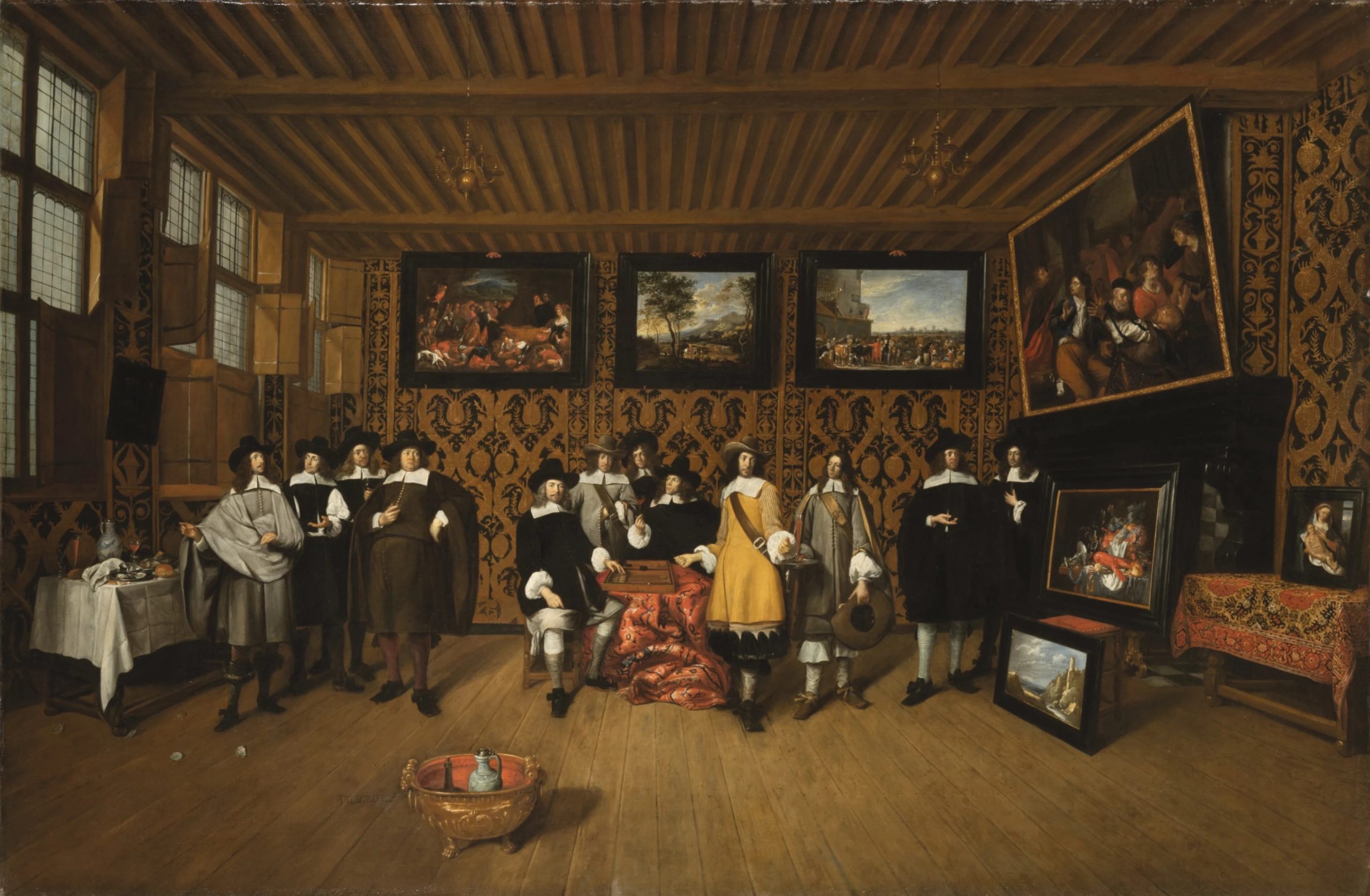
David Teniers and the Archduke’s princely art collection
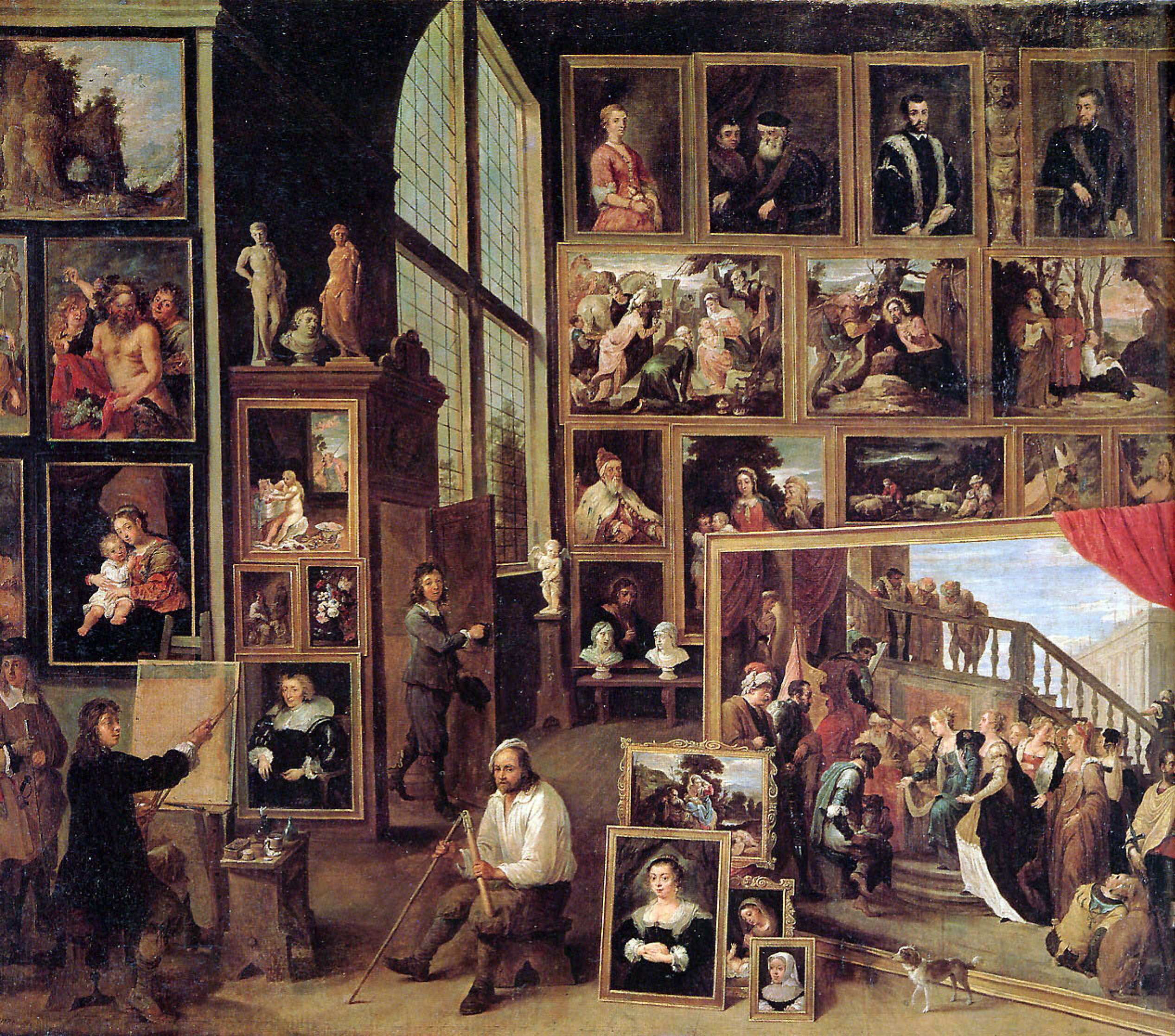
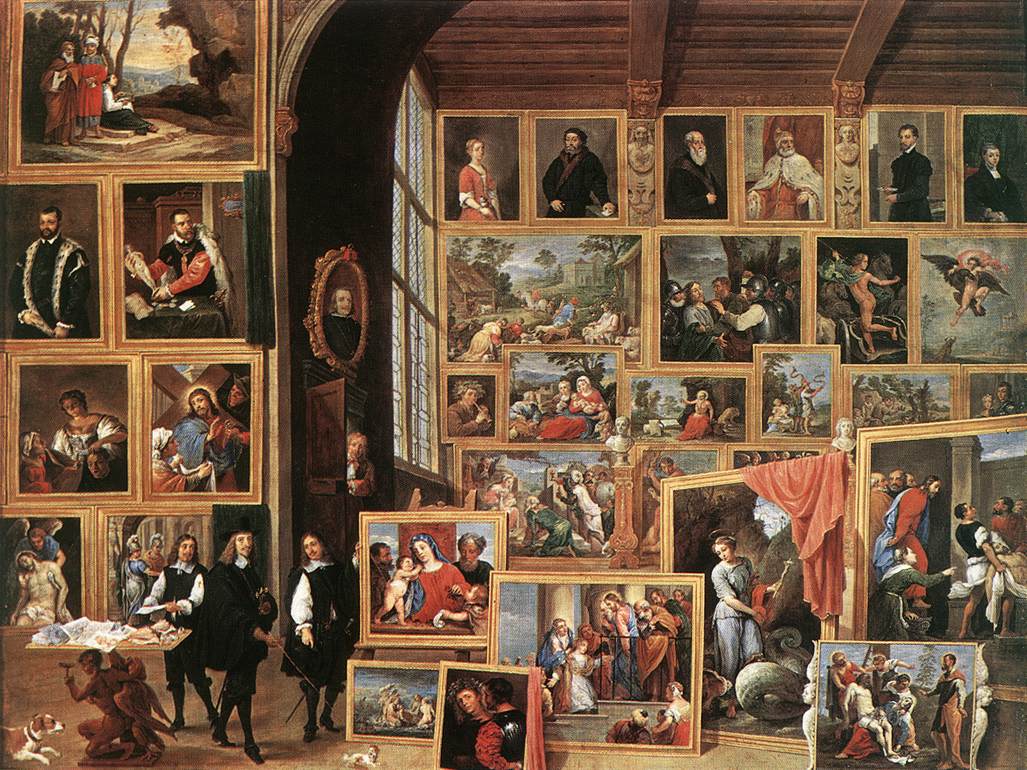
The Archduke Leopold Wilhelm of Austria (1614–1662) was one of those who had the means and the influence to amass a huge collection of artwork—over thirteen hundred paintings by leading Italian Renaissance artists of such fame as Titian, Raphael, and Giorgione, as well as of famous Northern artists such as Pieter Bruegel the Elder and Jan van Eyck. As court painter and curator of the Archduke’s private art gallery, David Teniers the Younger would be instrumental in cataloging his collection to share with the world.
Only a few years into his employ, Teniers completed ten paintings of the Archduke’s gallery, each with a different arrangement of artworks in what appears to be a fictional room. The Archduke is ubiquitous in each of the paintings—complete with his signature pointed stick, pointed shoes, and a razor-sharp nose to match—seen unabashedly inspecting the valuable works in his prized collection.
When seeing Teniers’ paintings, one might easily assume they are looking at duplicates until closer examination reveals some subtle differences: a new arrangement of paintings from the inventory, a differently colored drape, the addition or subtraction of a person in the Archduke’s entourage, and slightly changed poses. Even viewing side-by-side, the differences can be difficult to spot.
While the settings may not have been real, many of the paintings shown can be identified as reproductions of authentic works from the collection, meticulously rendered in miniature. To fit so many works into a single composition, Teniers reduced their scale and arranged them in tightly packed rows, squeezing dozens of paintings in magnificent cluttered abundance onto a single canvas.
Antwerp’s master guild painters and the flex of skill
The earliest gallery paintings were known to dip into the realm of fantasy, often including entirely fictional works or settings shaped only by the artist’s aesthetic sensibilities. But over the course of the century, gallery paintings increasingly became strict documentary works that left no room for imaginative wanderings. These were references to tangible paintings from real collections, many of them recognized as masterpieces that must be honored as such.
Within the halls of St. Luke’s guild of painters, apprentices and journeymen worked without rest, endlessly copying the styles of their masters. It was a practice of repetition that could eventually produce work that was indistinguishable from the master’s own hand. Only when the skill was successfully achieved could the student earn the right to become his own master. An experienced painter spent many years learning the art of copy, to broaden the mind and absorb new techniques and regional styles; it was a skill to practice and flex, during a time in history when imitation was the highest form of compliment.
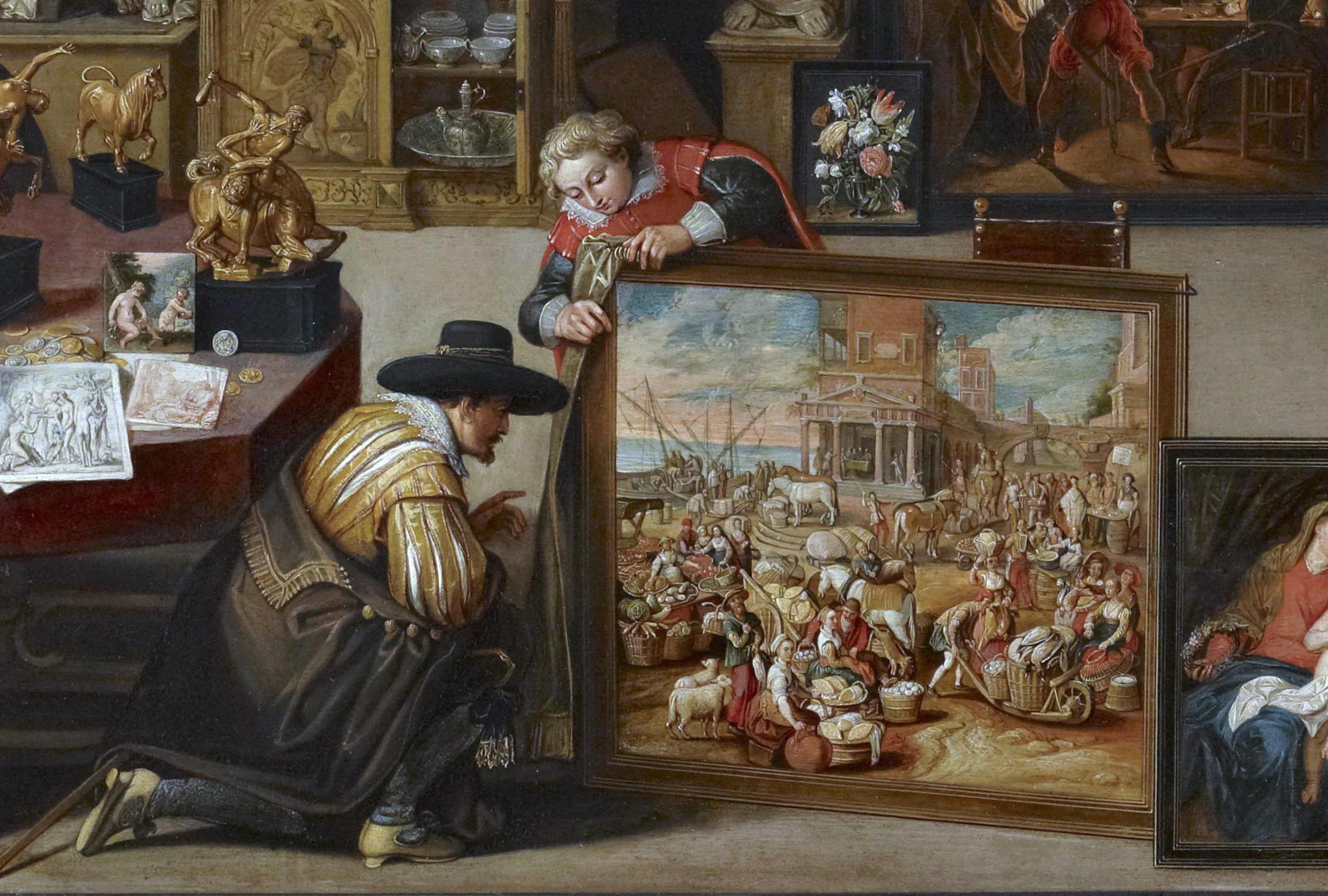
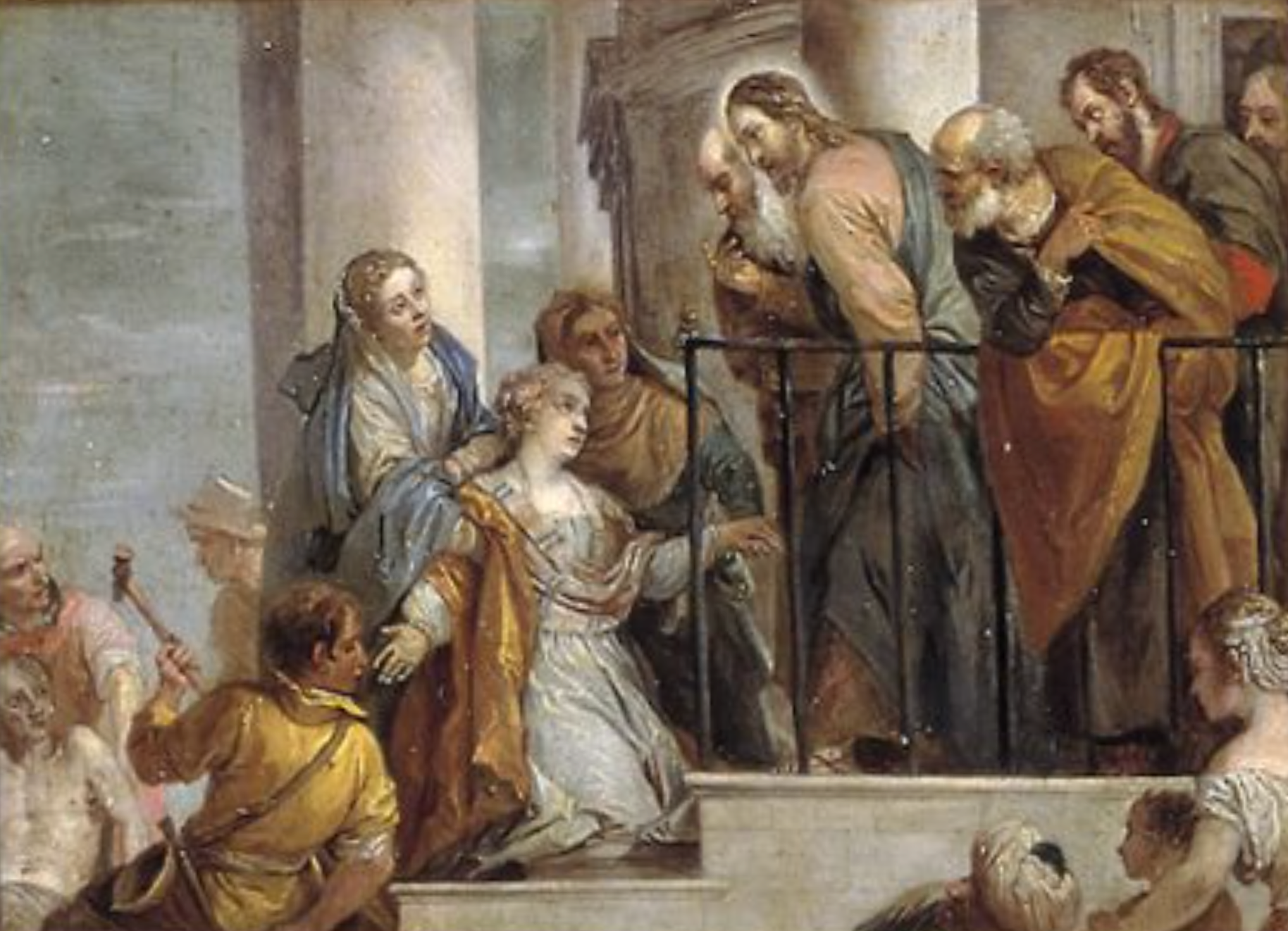
Painting tiny, detailed copies of works by greats like Rubens or Titian gave artists a way to boast immense technical range, not just by imitating their methods, but by recreating them in miniature. The smaller versions in a gallery painting were often faithful reproductions of the original, larger works, sometimes becoming technical masterpieces in their own right.
David Teniers the Younger’s ability to copy famous masterpieces was a skill he gained as a young apprentice to his father, who was a well-known master guild artist in Antwerp. The elder Teniers was not so skilled with his money as he was with the brush. Plagued by financial woes of his own making, he found himself familiar with the interior walls of the dreaded debtor’s prison on more than one occasion. As a result, the responsibility for supporting his family often fell to the shoulders of the younger Teniers. The young man turned to making quick copies of great paintings by the masters to sell for profit to the buyers who desired to own a piece of prestige, for a fraction of the price.
After years of repetition and practice, Teniers became a technical expert, able to demonstrate the many different styles and methods of the greats who came before him. Not only this, but as we can see in his gallery paintings of the Archduke’s collection, he could do it at a fraction of the scale of the original. One only needs to expand the modern glowing screen in front of them to see the scenes on tiny canvases take on a complete life of their own.
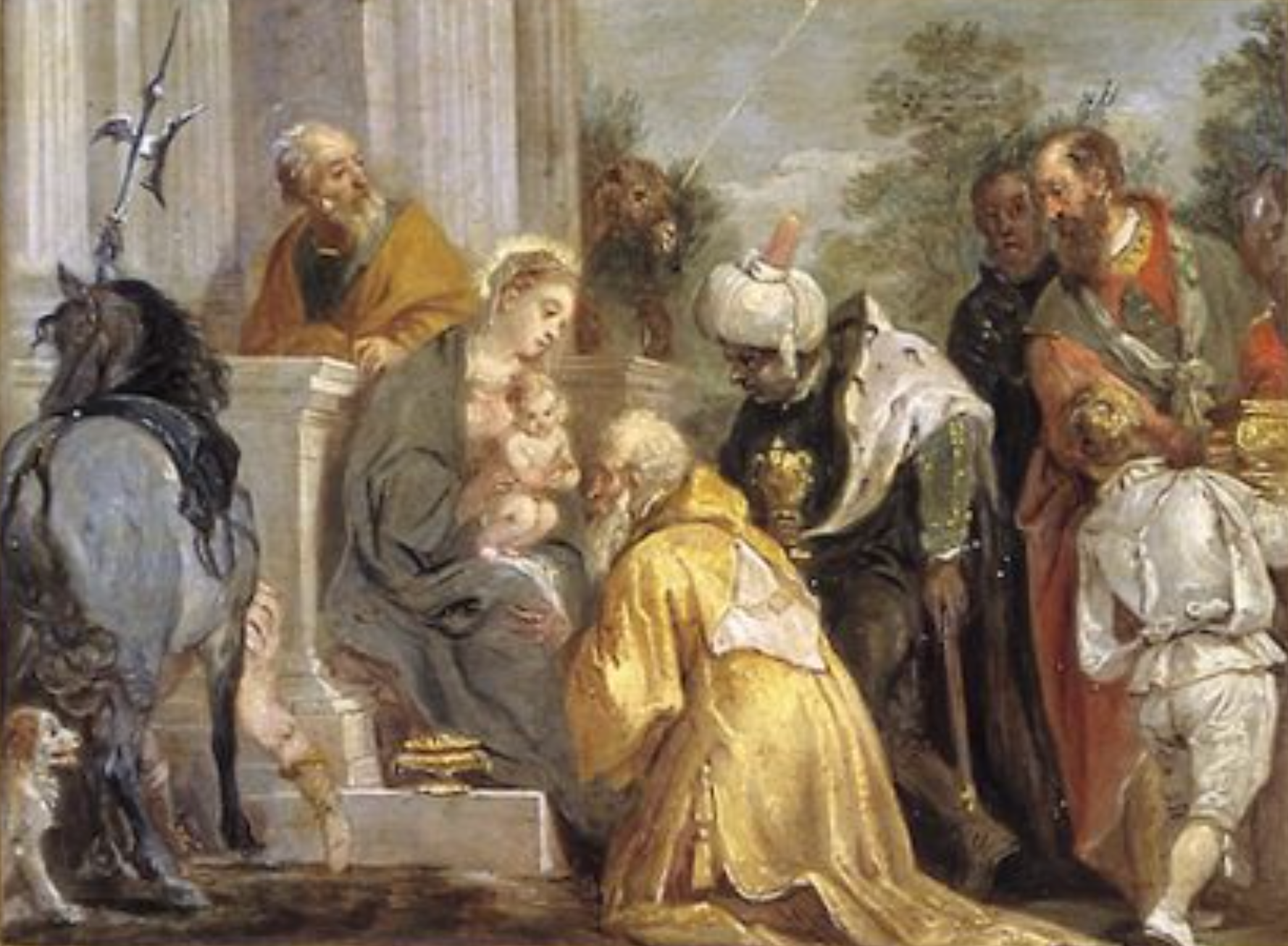
Willem van Haecht and the discerning intellectual
But what value does a collection have if there is no one to view it?
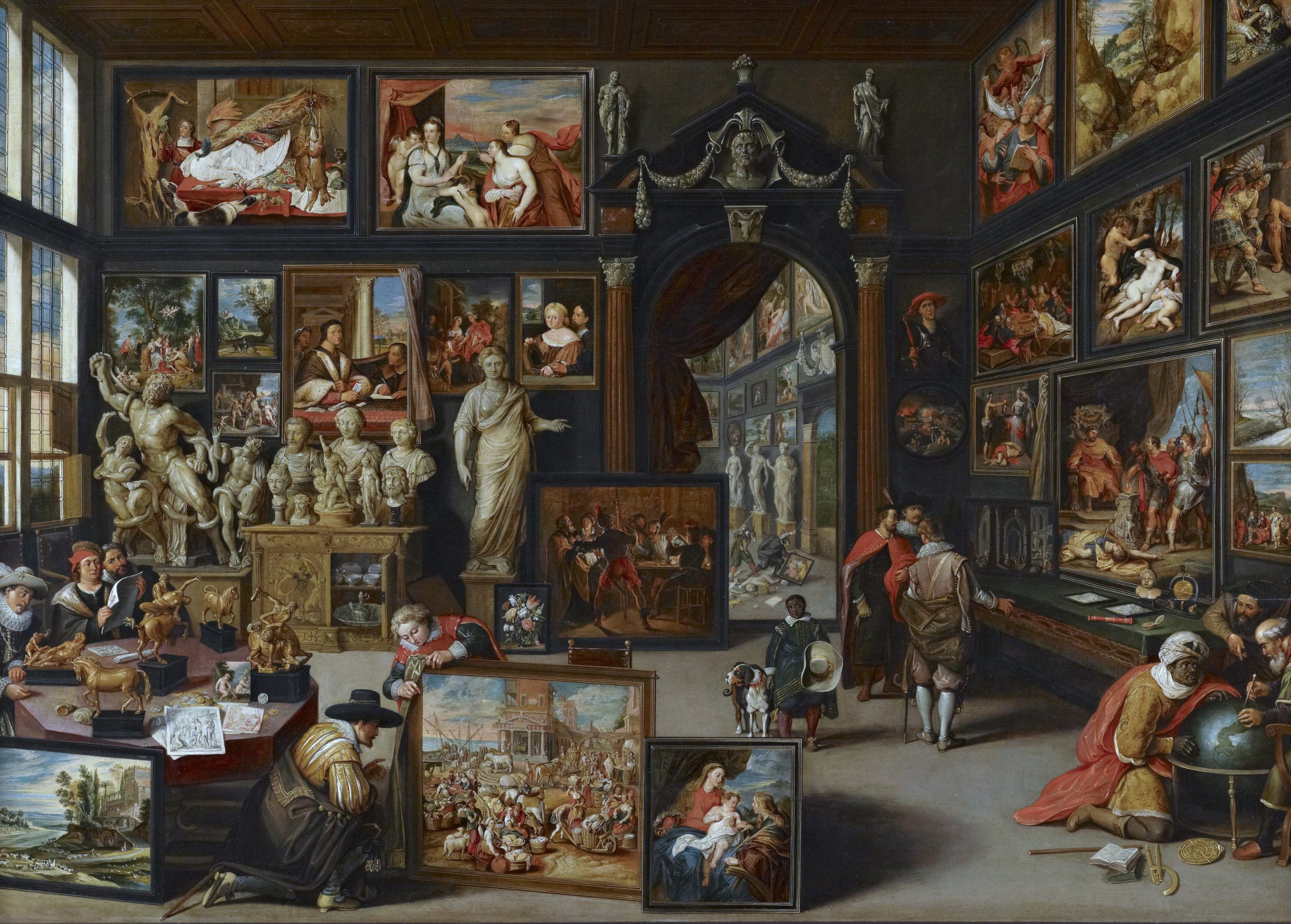
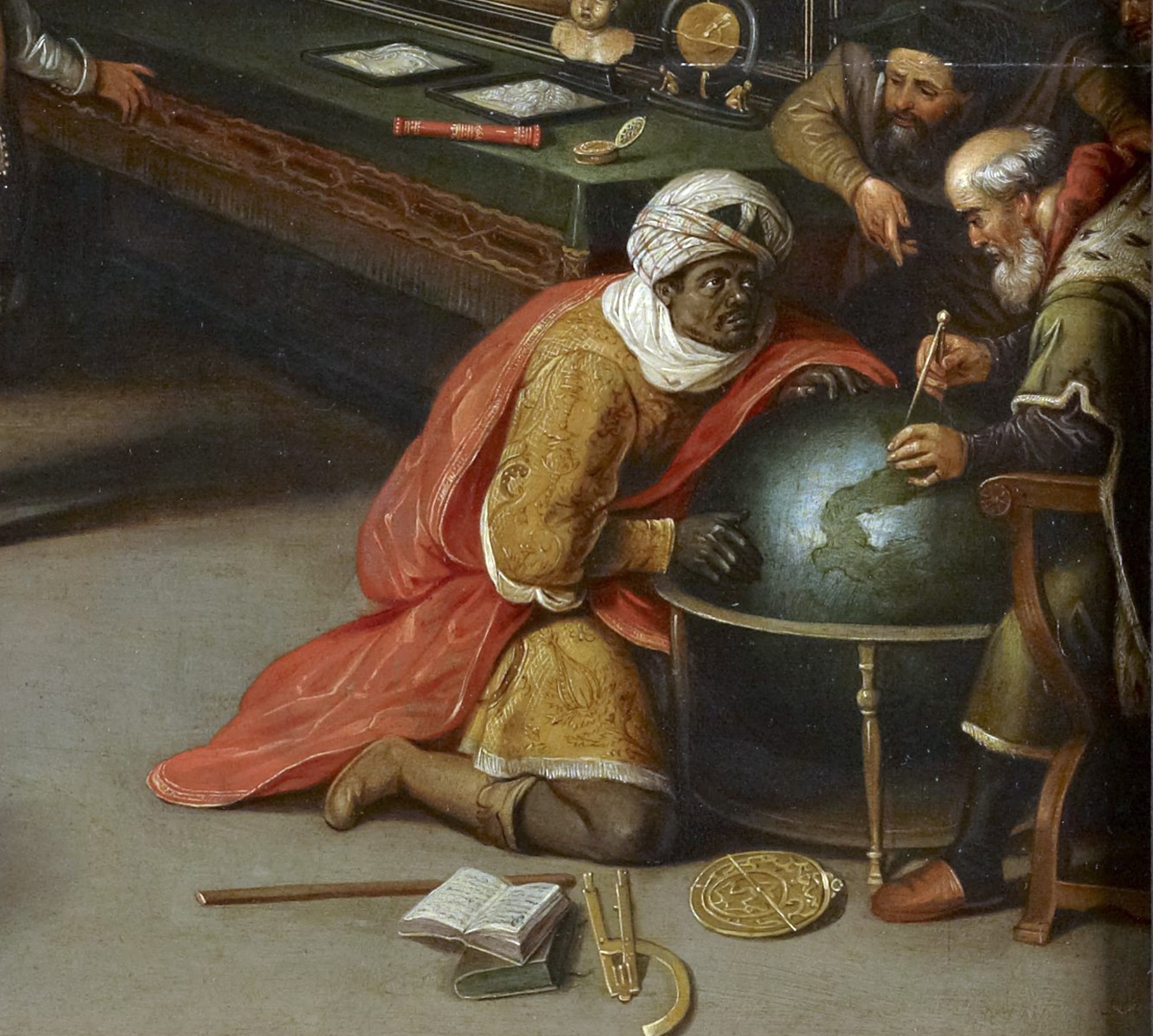
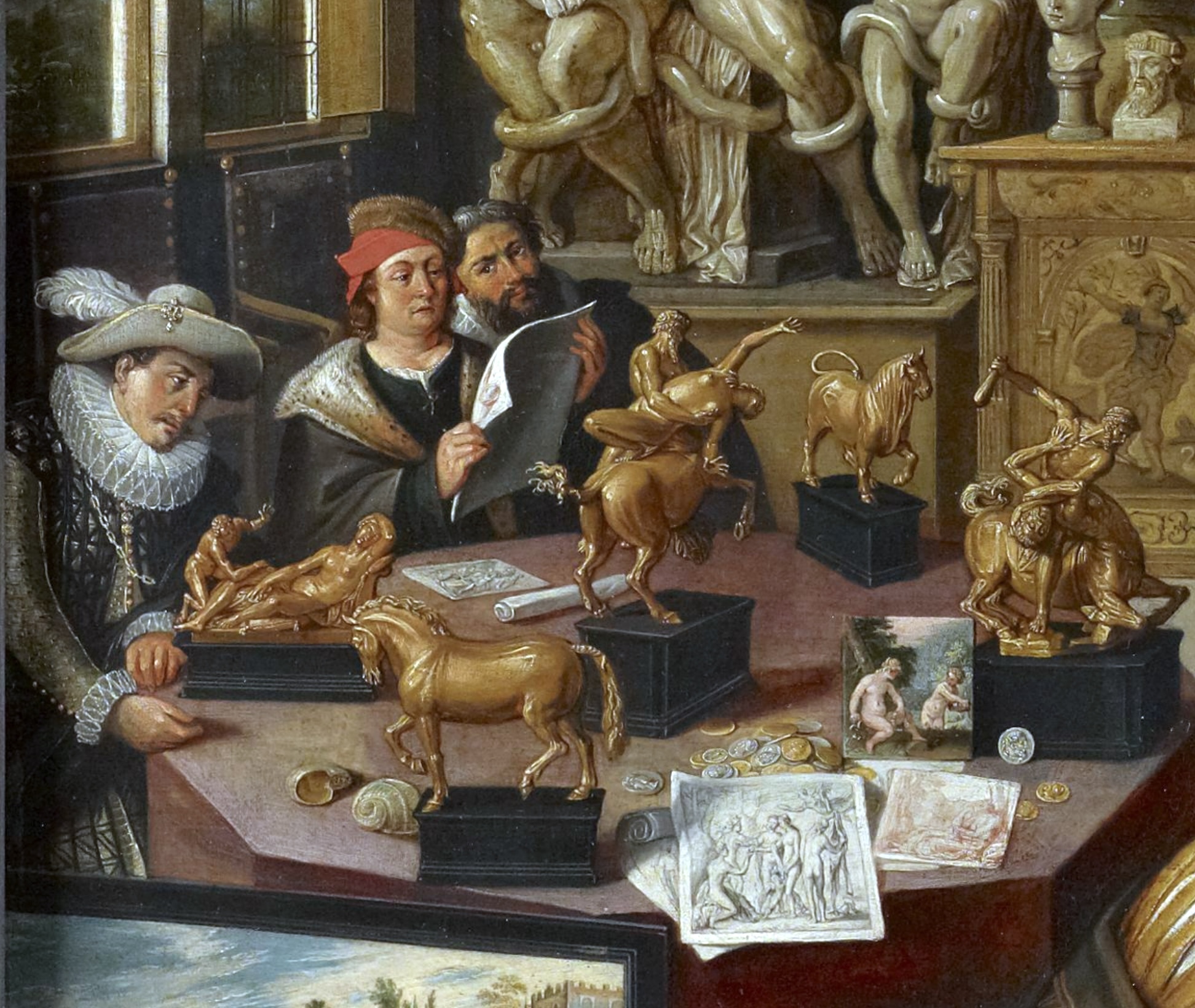
Omnipresent in every grand gallery painting are the intellectuals, the connoisseurs, and the curious browsers of the arts. One can usually spot the owner of the collection alongside a handpicked retinue of prominent guests, scholars, and society’s luminaries. Paintings, overflowing from gallery walls, were often accompanied by other artistic works and artifacts of science—sculptures, globes, maps, books, scientific instruments—piled high on tables and spilling over to the floor. Prominently positioned visitors can be seen discussing the objects intently and examining artworks in the gallery, at times on bended knee or posturing with hands on hips and the pointed foot ever forward.
Their presence is a reminder that galleries reveal as much about the viewer as the art itself—not just their tastes and intellect, but the desire to be seen as a discriminating viewer. In this way, the gallery patron becomes the subject of the artwork as much as the collection itself.
The Flemish artist Willem van Haecht (1593–1637) paints us a glimpse into the gallery of Cornelis van der Geest, one of Antwerp’s wealthy merchants of his day, where clusters of men and women press together in fervent discussion over the various intellectual and no doubt very expensive objects in the room. It’s notable that the figures in attendance seem to jockey for a prominent position nearer the celebrity guests in the room; no one’s back is turned, and no faces are obscured. Is the subject of this scene the artworks or the audience?

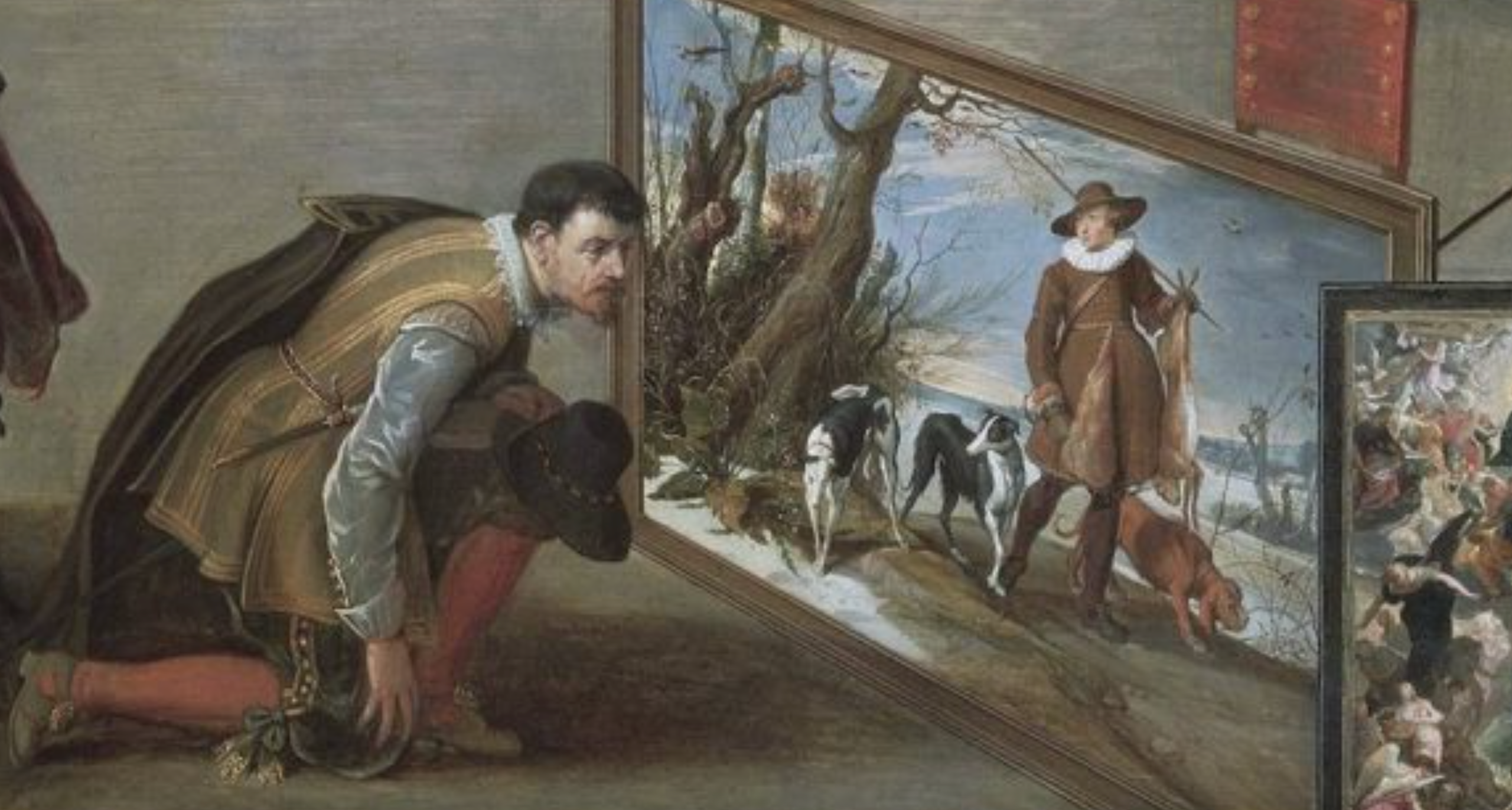
The Brothers Francken and the iconoclast donkeys
The gallery painting did not always content itself with being strictly literal. It became an engine for commenting on relevant issues of the moment, hiding its messages within plain sight. Artists returned again and again to certain themes in their paintings, occasionally slipping in allegorical imagery on repeat. The images are not always apparent at first glance. You have to look closer.
Enter the iconoclast donkeys.
The mystifying appearance of humanoid donkeys smashing valuable works of art, spotted in a series of gallery paintings by the brothers Francken, can be explained by examining the Protestant Reformation of fifty years prior. The widening rift in religious ideals prompted a months-long wave of violent destruction of Catholic imagery across Europe, with mobs destroying altarpieces, stained-glass windows, sculptures, paintings, frescoes, and books, viewing them as idolatrous “papist superstitions.”
The wounds from these furious acts against the arts, in particular to the artist community, were still painfully fresh. The satirical allegory of the donkey-headed men—‘Anes Iconoclastes’—offered a harsh critique to this religious fanaticism and intellectual ignorance, for only the truly small-minded would destroy such irreplaceable and beautiful works of art—a foolishness and ignorance that we associate with the ass.
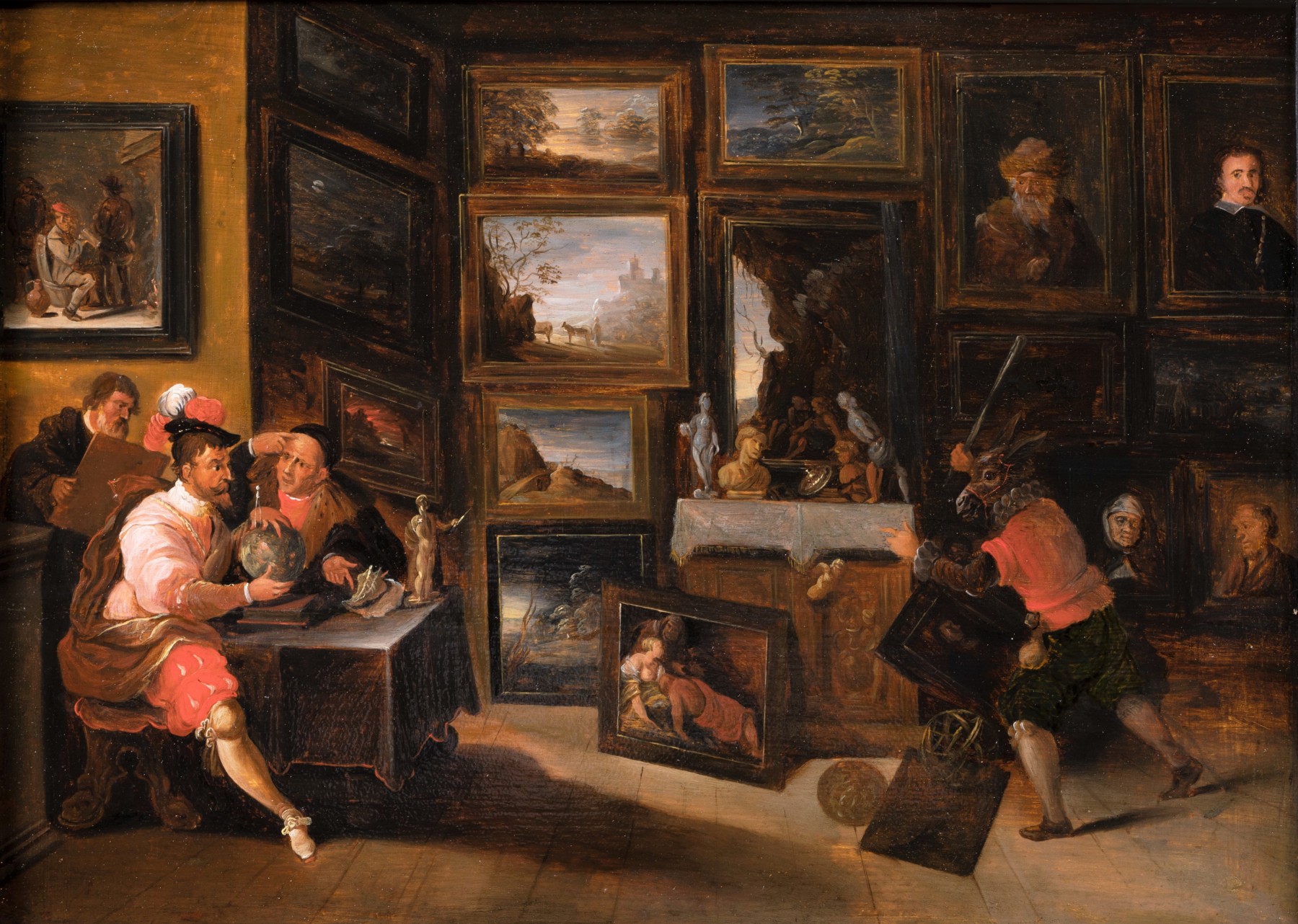
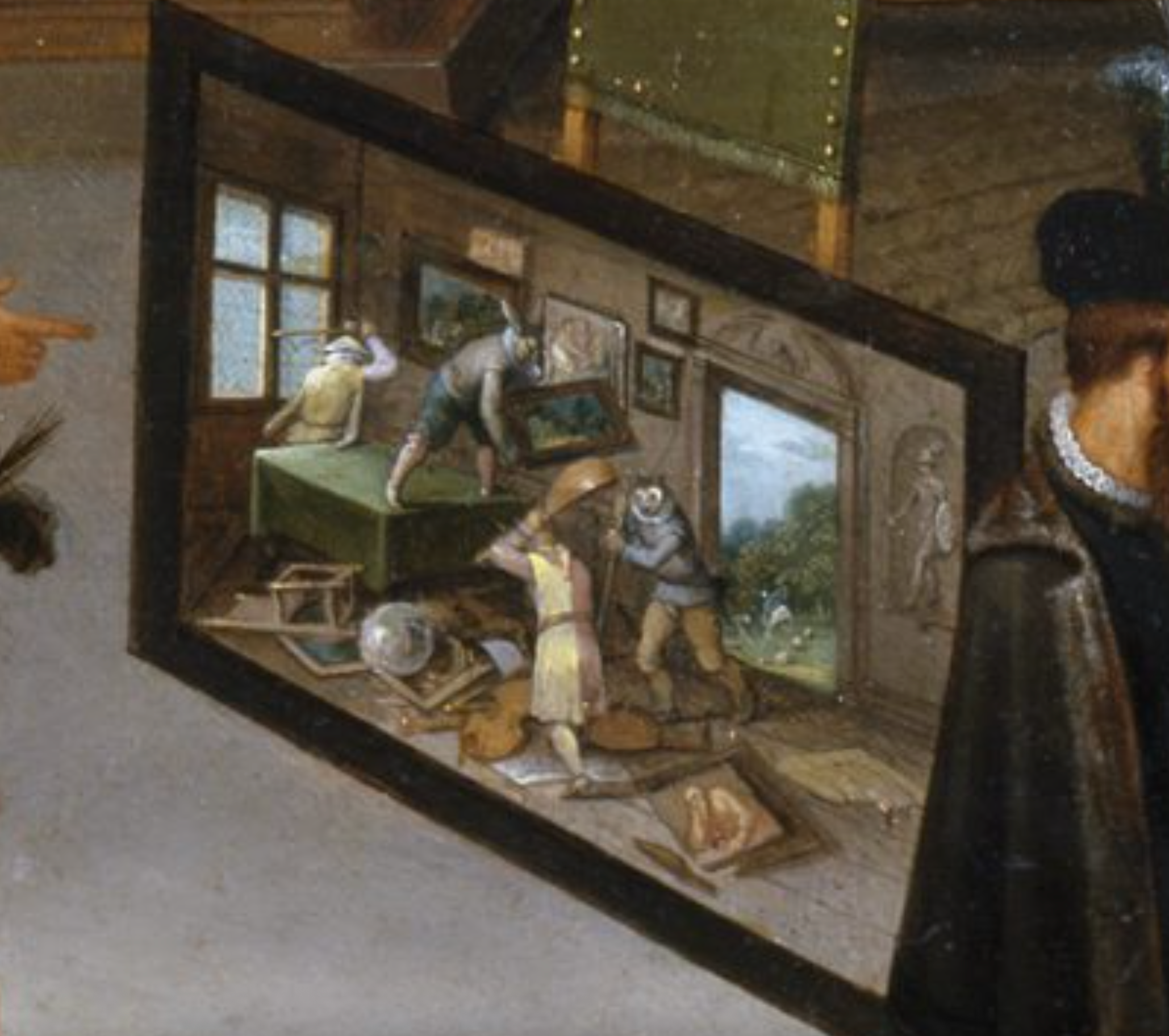
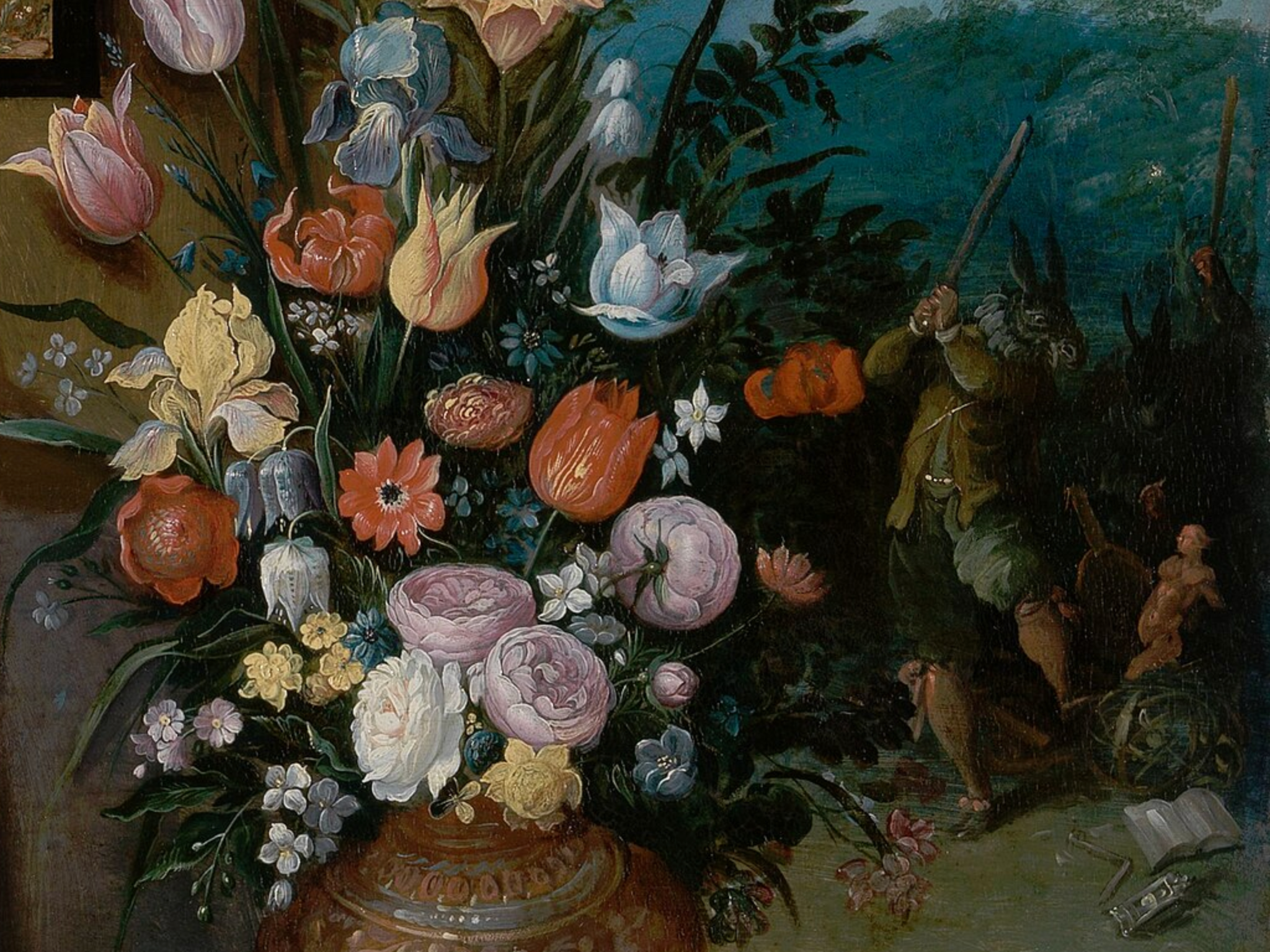
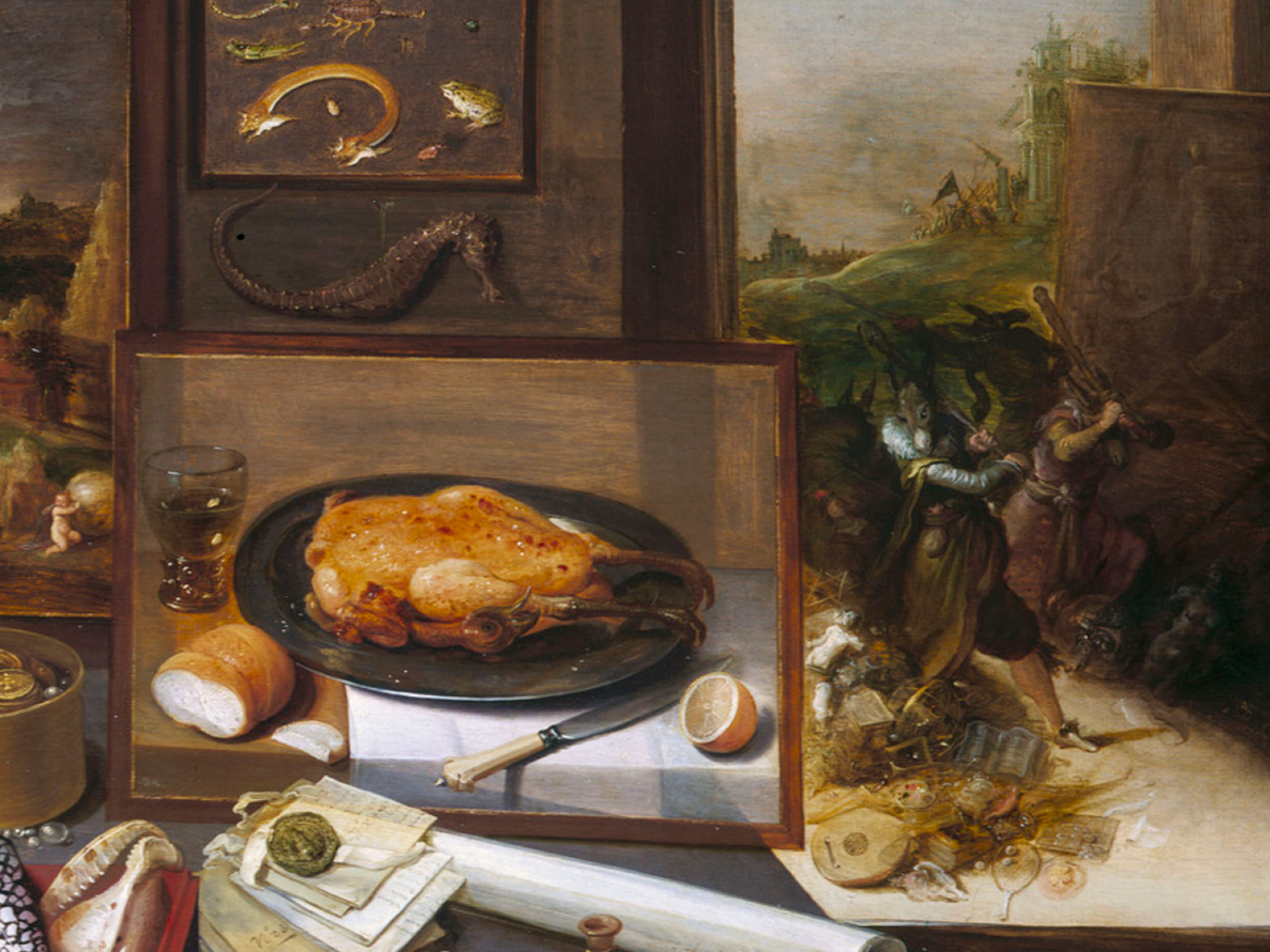
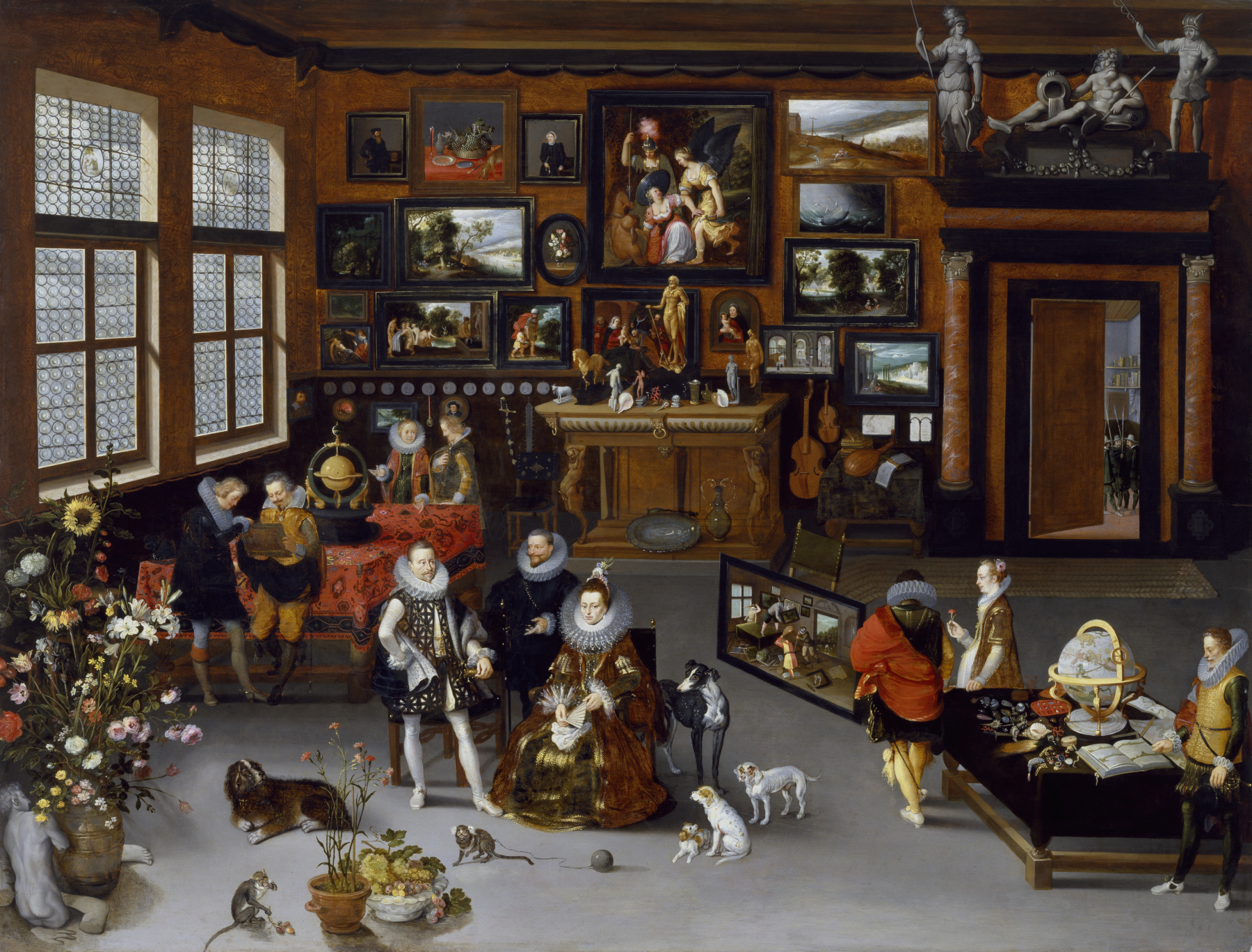
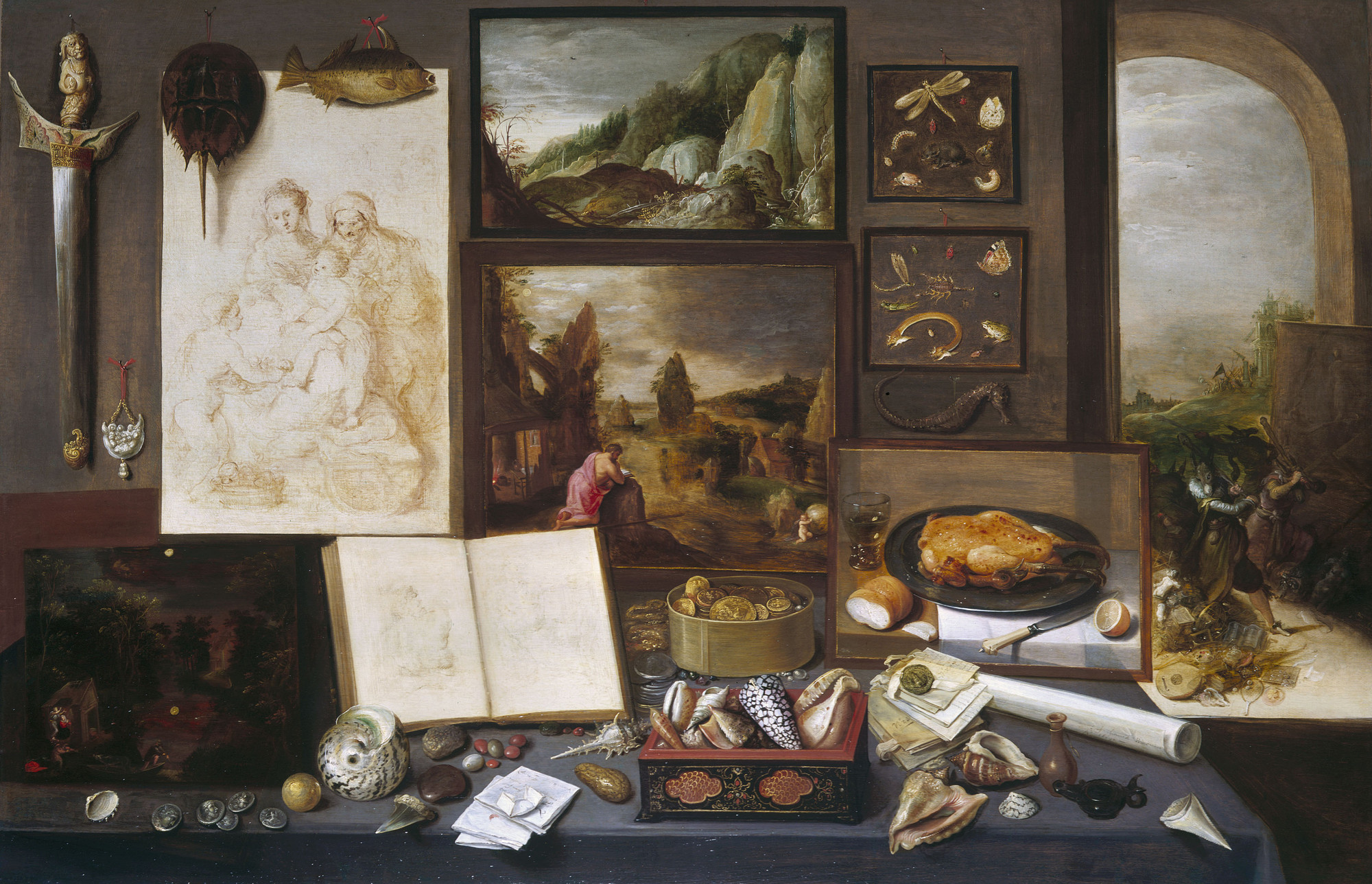
Frans Francken the Younger (1581–1642) returned to this theme several times in his gallery paintings—the donkeys are there, pulling art from the walls and smashing musical instruments with wooden clubs held high. Hieronymus Francken (1578–1623), his brother, included miniature versions of the destructive animals in his scenes of The Archdukes Albert and Isabella Visiting the Collection of Pierre Roose and The Sciences and Arts (both views of the same gallery), which you can spot if you look closely enough.
Frans Francken II and the cabinet of curiosities
Modern-day art galleries and museums owe their origins to the cabinets of curiosity that rose in popularity in the early seventeenth century. A curiosity cabinet was a visual memory theater that resided in a special place in the home of the noble or wealthy, a cabinet or a shelf, dedicated to the encyclopedic display of rare and exotic objects. These microcosmic collections showcased, in artfully curated yet wonderfully cluttered arrangements, the wonders of the natural world alongside the artifacts of human knowledge and achievement—naturalia, scientifica, and artificialia.
The human interest in the classification and organization of knowledge found a natural home within the space of a curiosity cabinet; it created a stage for viewing, contrasting, and contextualizing, where the narrative value of the whole could exceed the sum of its parts. Viewing the carefully curated tiny wonders contained within a cabinet of curiosity was decidedly more intimate than that of an expansive art collection—a private pleasure to be enjoyed by the collector and a chosen few.
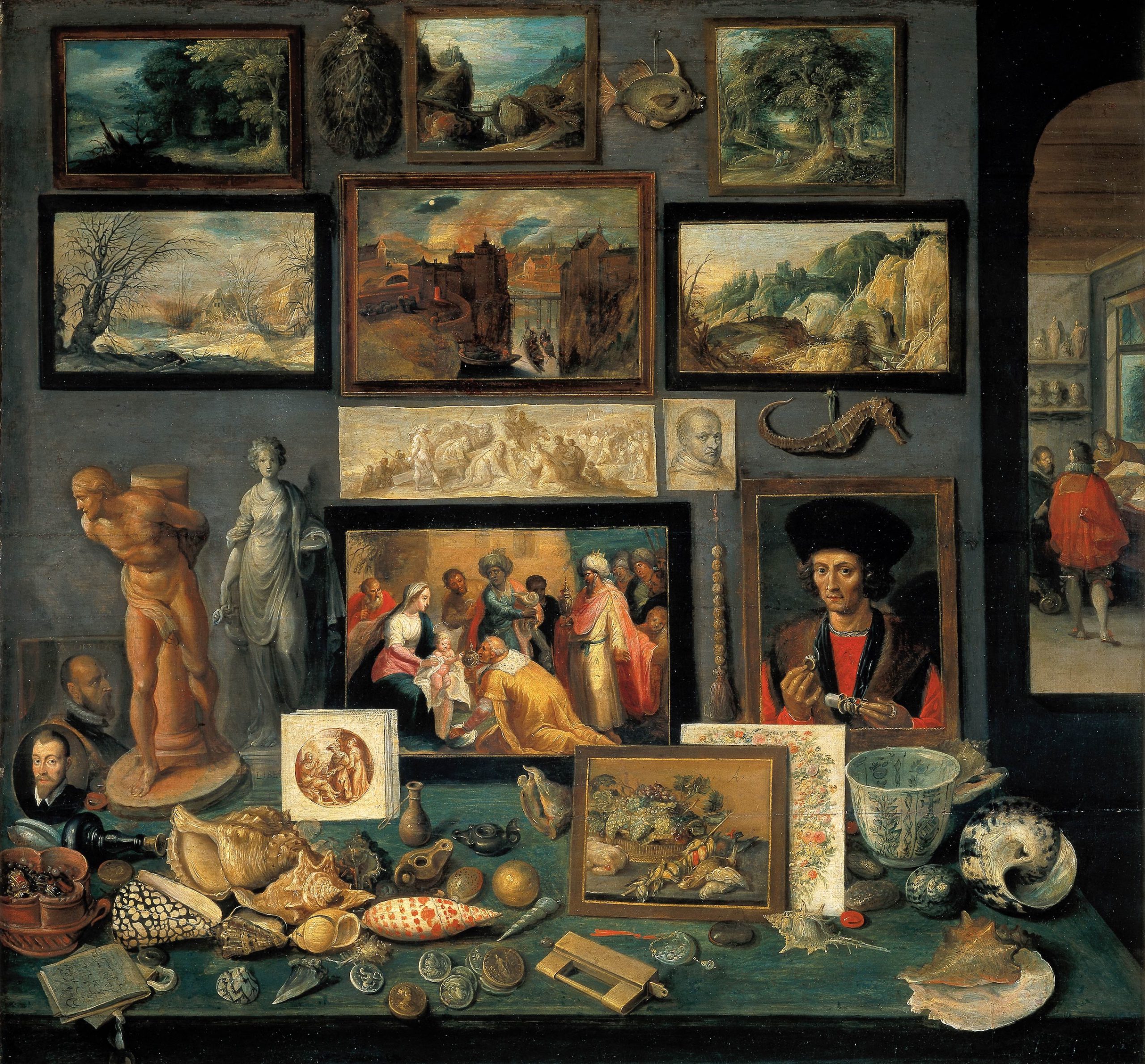
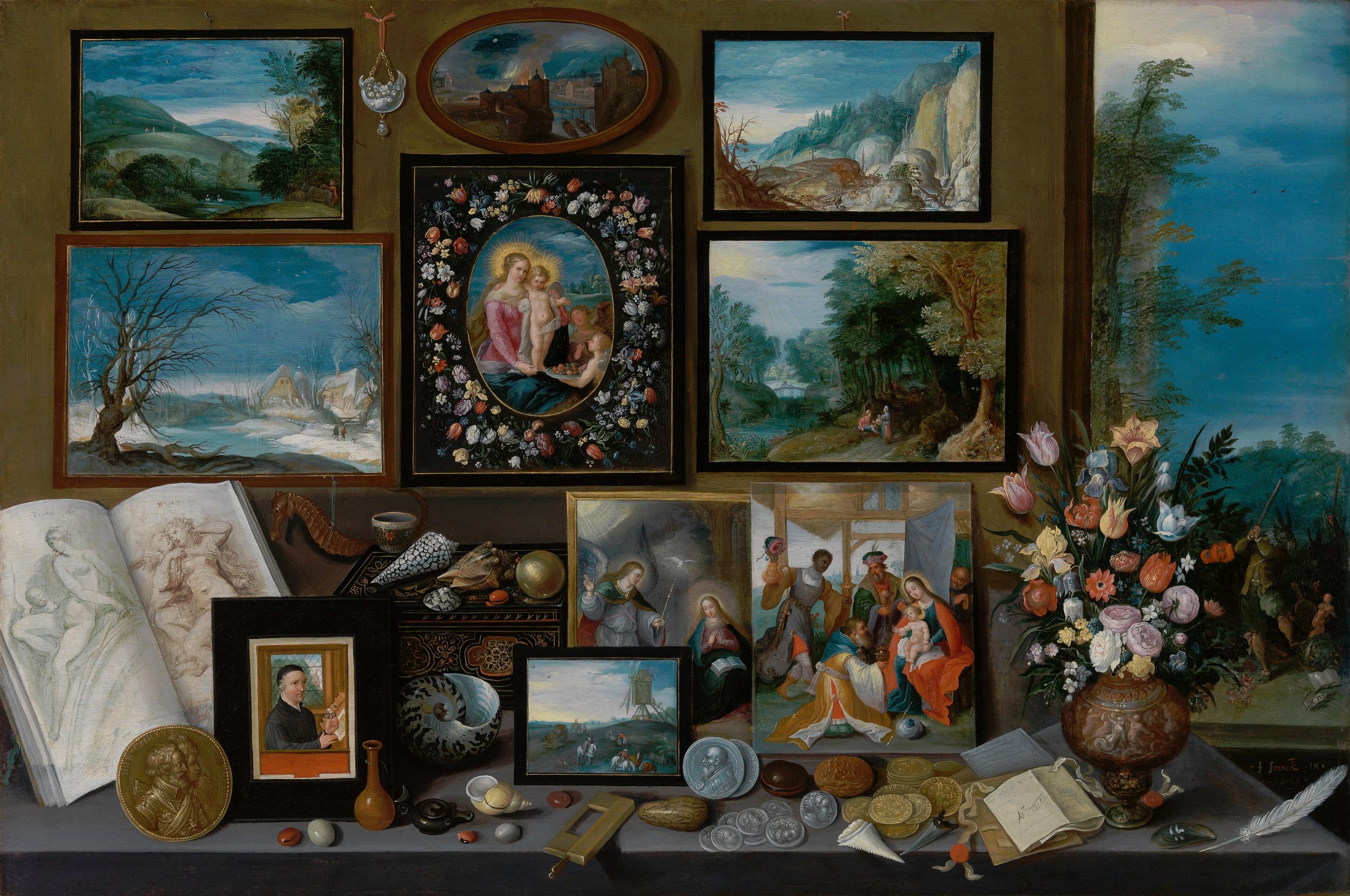
Artists naturally found inspiration in the visual complexities of the curiosity cabinet and translated them into a painted meta-genre of its very own: art and objects piled together within a quiet corner of a room, made more precious by the sheer density of their composition. In the format of a canvas, the artist was able to paint out any distractions that could steal intimacy from the scene. People are absent, except for perhaps a glimpse of some distant figures in the background or in an adjacent room, preoccupied with their own affairs—leaving you, the viewer, in quiet contemplation of the wonders before you.
Frans Francken the Younger painted dozens of iterations on the theme: cabinet tops lush with sketches and sculptures, rare coins, shiny shells, entomological displays of rare insects, and exotic feathers. In doing so, he established the conventions that would define the cabinet painting—a niche genre that would quickly become a major European trend, inspiring the grand-scale gallery paintings of David Teniers and others that would follow a few short decades later.
Cornelis Gijbrechts and the trompe-l’oeil
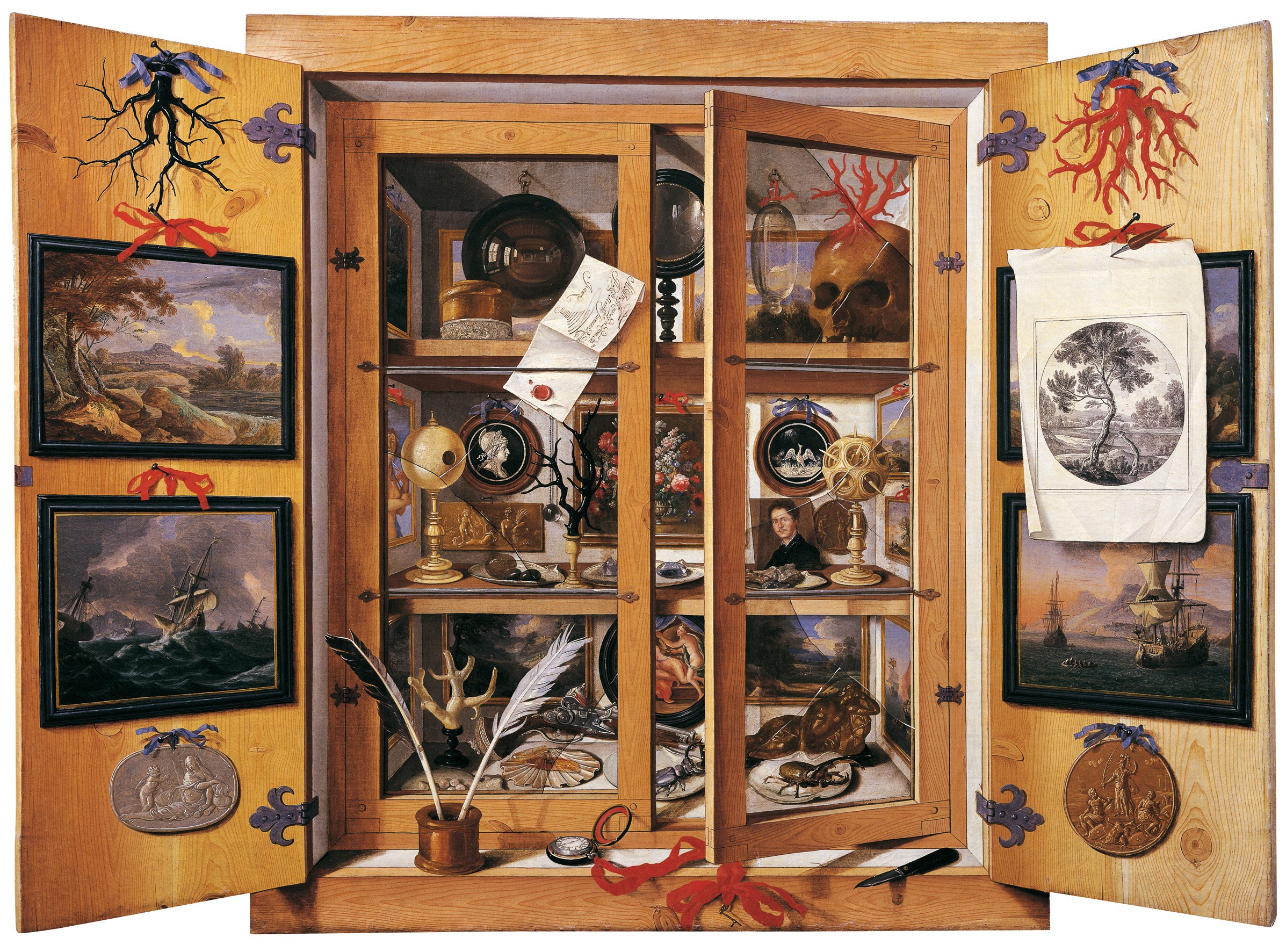
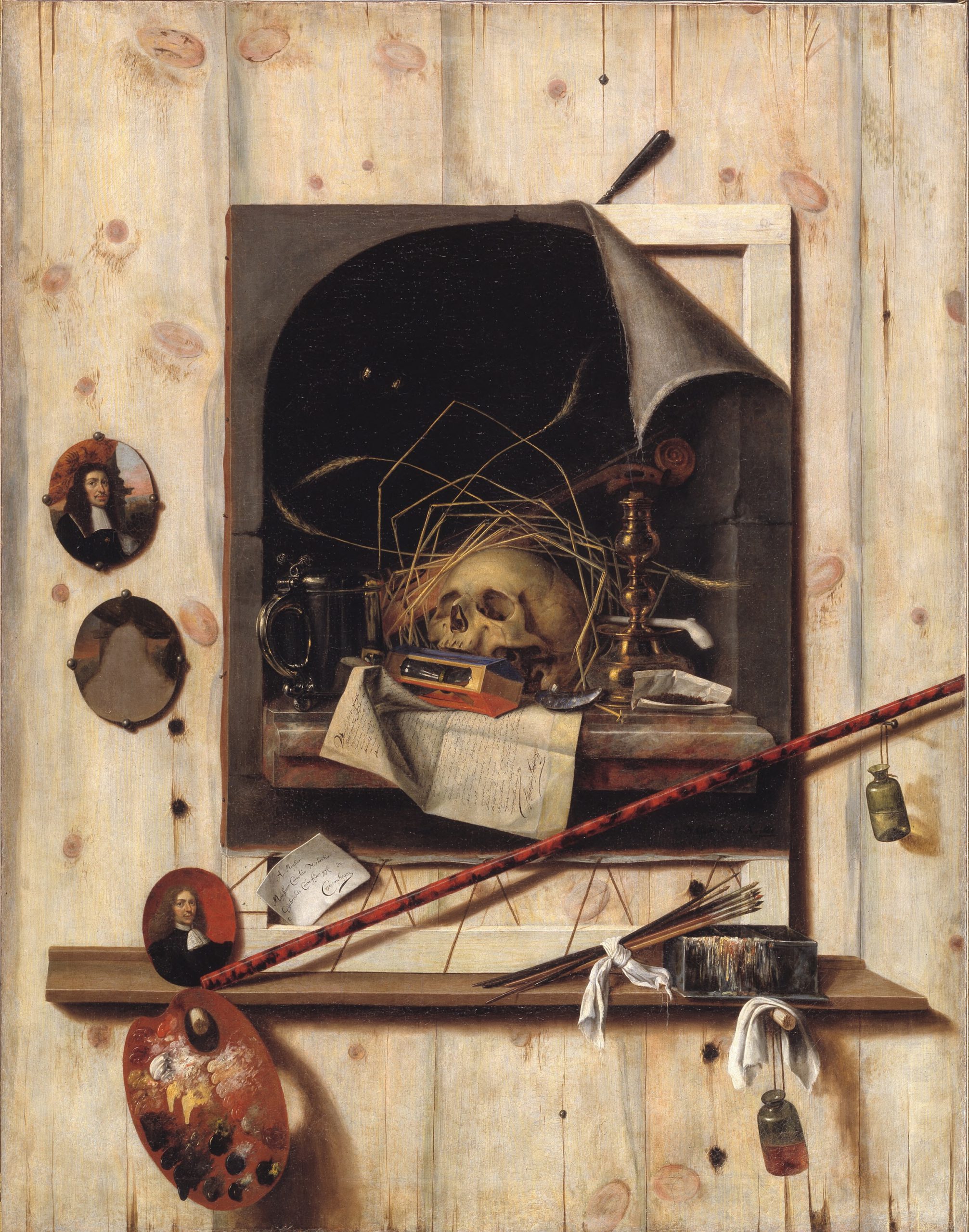
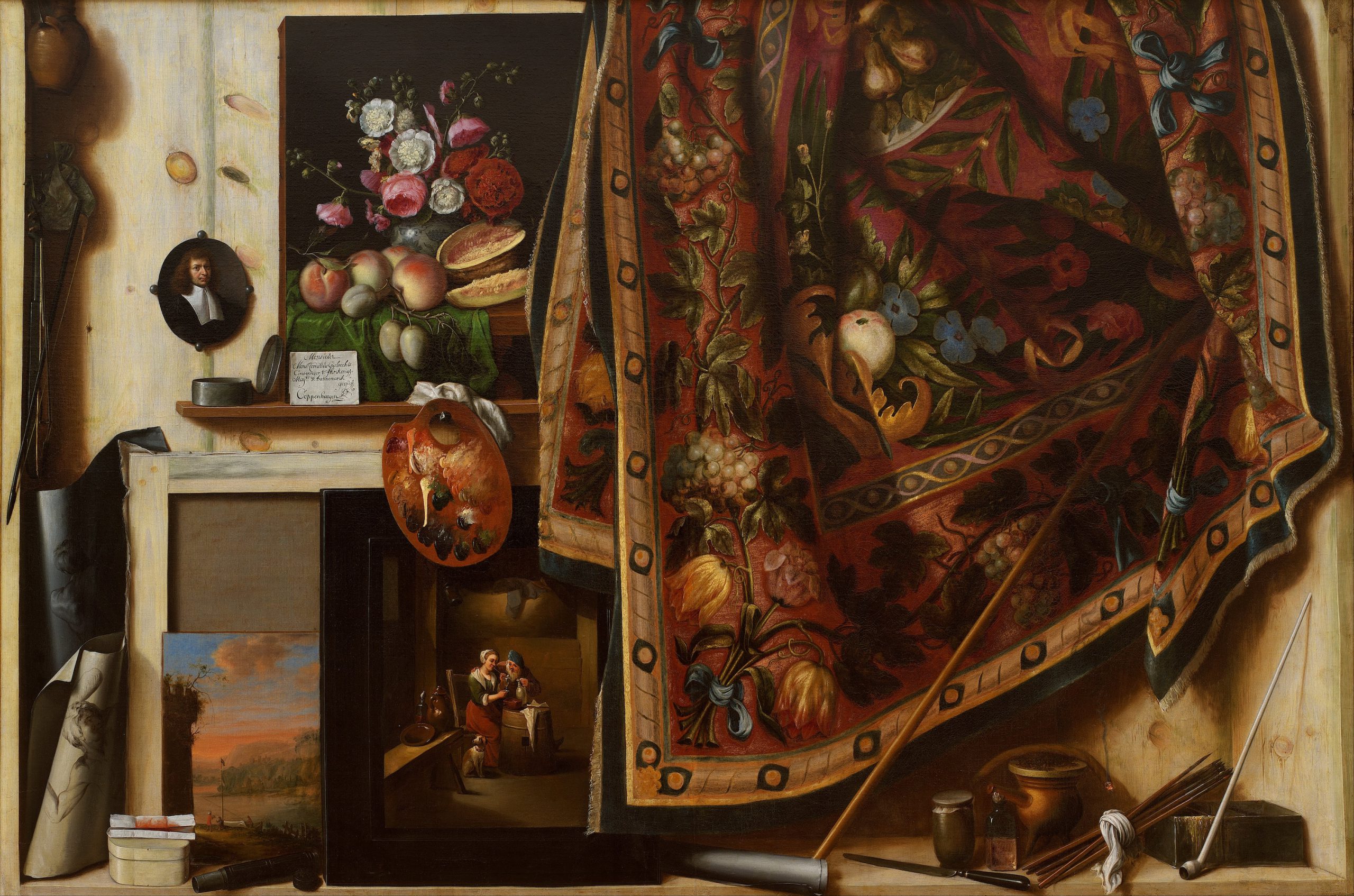
Gallery paintings again took a turn toward the minimal later in the century as a new genre emerged in Netherlandish paintings: the still life. The still life gallery painting was immediately more intimate and self-referential by leaning into the process of its own creation—usually a quiet studio setting cluttered with canvases, brushes, palettes, and paint, where people are notably absent except for in embedded artworks. Gone are the posturing crowds of the grand galleries, and the tiny wonders of the curiosity cabinet have been replaced by treasures of a different sort, those that appeal more to the ideals of the creative: the daily ephemera of the painter.
The style that would command the still life painting was tromp-l’oeil, meaning literally “optical illusion”—a hyper-realistic technique using deep shadows, bright highlights, and forced perspective to mimic the look of three-dimensional objects. The eye is fooled into thinking that the objects are tangible; you only need to reach out to touch them.
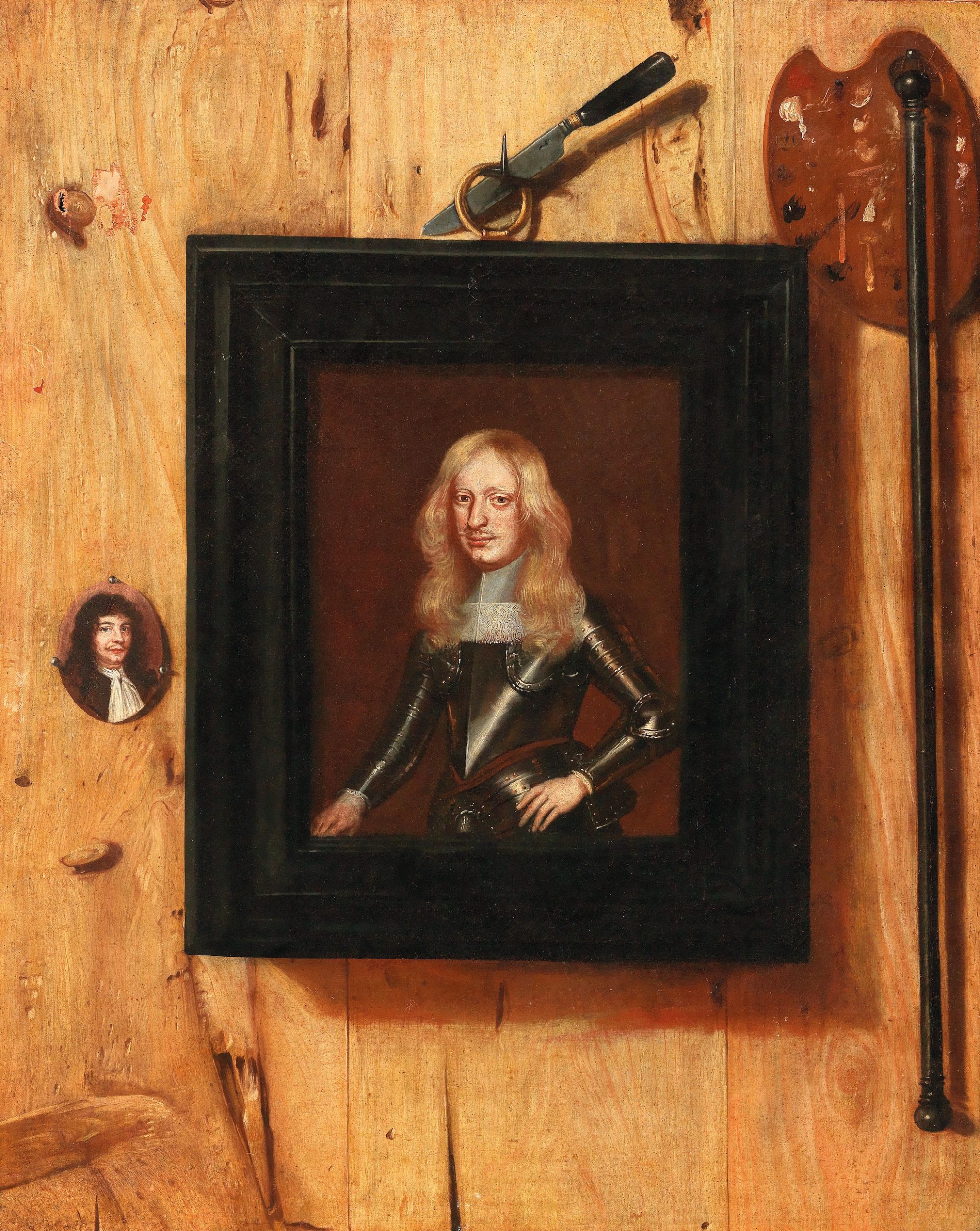
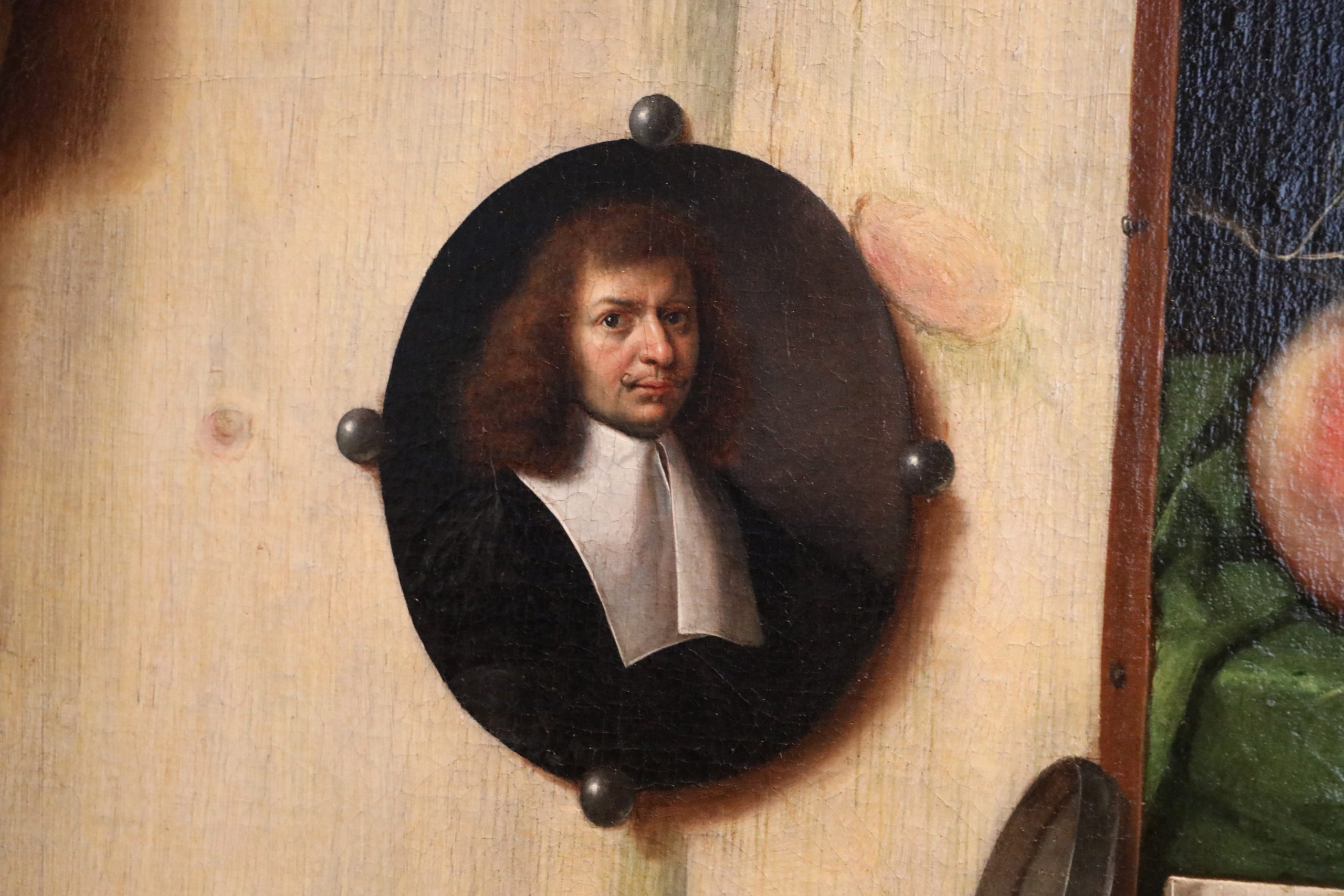
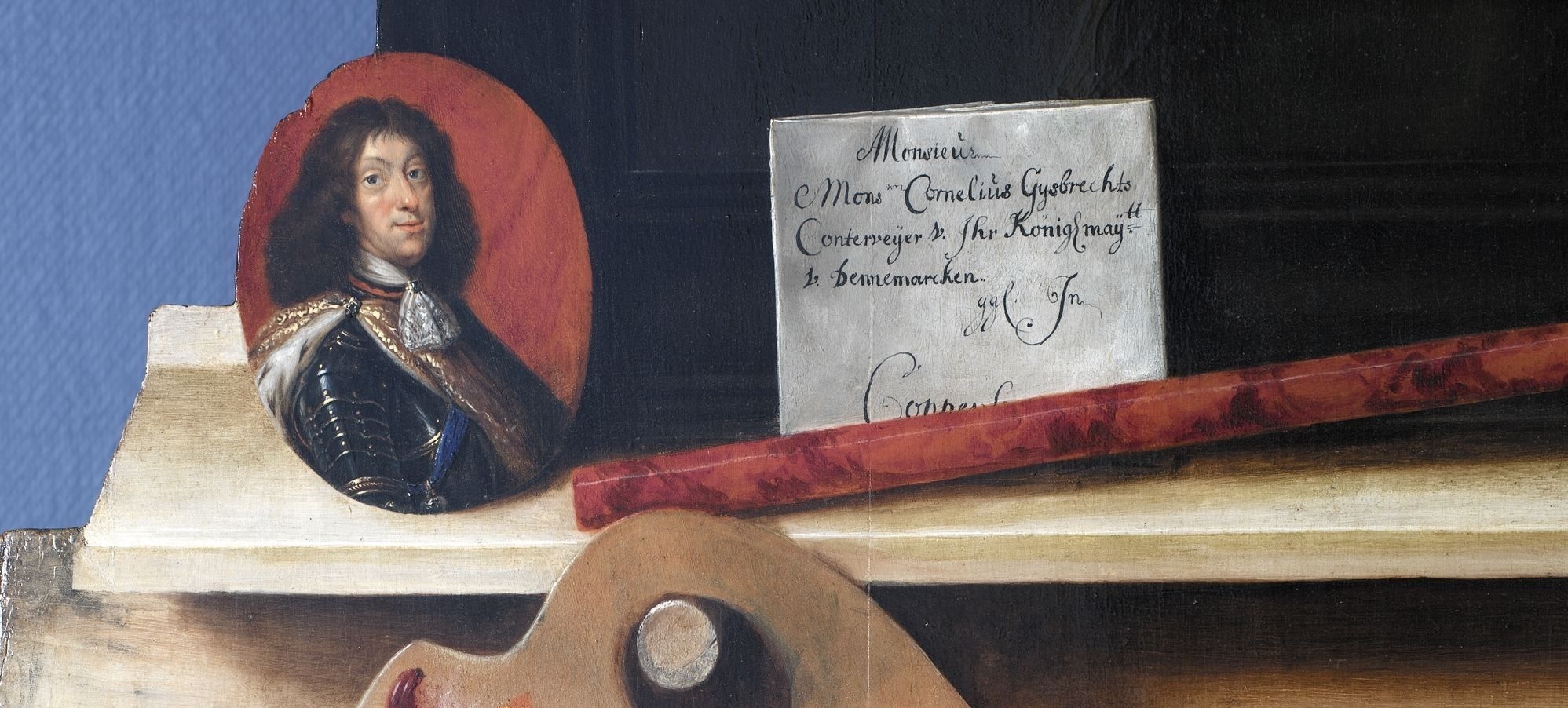
A master of trompe-l’œil was the Flemish artist, Cornelis Norbertus Gijsbrechts (1630–1683). His works iterate on the gallery theme of the previous decade, where the subject of the painting is a collection of paintings in an artist’s studio, with Gijsbrechts’ own preference for self-portraits, rendered in miniature and pinned for display in a candid arrangement of artistic clutter. In his Trompe-l’œil With a Portrait of a Soldier, a Portrait Miniature and a Palette, a knife spears a portrait to the wall, jutting toward the viewer with startling realism, casting a sharp shadow across the knots and grains of the wood paneling behind it. A palette suspends nearby, still wet and dripping with oils, as if the painting has been completed and the artist has only just stepped from the room.
There’s something visually seductive about the meta-painting that captures one’s eye—a quest to see more, to hunt out every detail, to question the boundaries between what is real and what isn’t. To contextualize the objects and find their hidden meanings. It tugs at the human tendency to collect and to be collectors. The desire to compare and contrast. To see and be seen. To judge, and be judged favorably.
Throughout its evolution, from cabinets of curiosity to grand museums dedicated to the arts and sciences, to the humble painter’s studio captured with perfect realism, the gallery painting was a fresh and unique perspective on the art of art. The Flemish painters of seventeenth century were true innovators, continually re-inventing the genre to delight the eye and trick the brain. Their creations do not simply depict the world; they reflect on how images function within it, demonstrating a self-awareness that was missing from much of the art before its time. By turning collections into compositions, and the compositions into subjects, gallery painters created works that became meditations on the act of seeing itself.