The Legacy of Earl Morris at Aztec, New Mexico
From his beginnings as a pot-hunter to becoming one of the most influential archaeologists in the American Southwest, Earl Morris left behind a legacy that endures to this day.
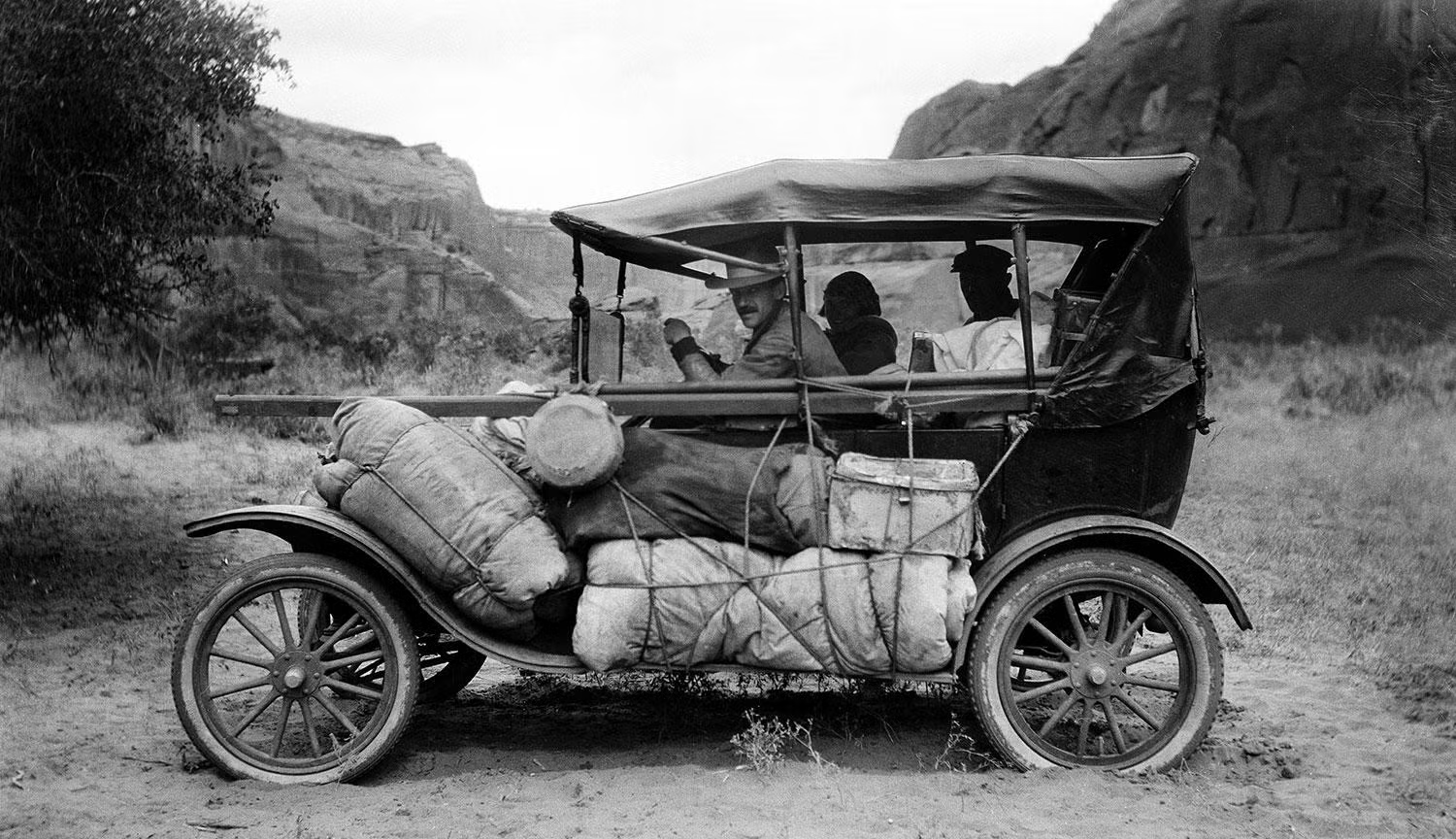
The soft mortar of the masonry gave way beneath the shovel’s blade and crumbled inward, opening a shaft into the subterranean room beyond. A young boy and the man with him crouched to pass through the small opening in the west wall of the great ruin, tumbling over sandstone bricks into the darkened chamber to escape the bitter chill of the desert winter outside. The smell there was of old things—dry husks of ancient corn, rodent excrement, ash, dirt, and sand—undisturbed by the flow of fresh air for more than six centuries.
Something ancient still dwelled in that place.
The shapes of the room emerged by the dim flicker of the lantern—a slope of intruding desert sand, a wall sagging inward, and to the left, a low adobe platform constructed against the southern wall. Upon it lay a skeleton, folded as if asleep. The white leg bones were drawn up to the chest, resting against the rib cage.1
The boy had seen the skeletons of beasts before, their scattered remains battered to chalk-white by the windswept sands. But these bones were different. He recognized the form to be human. His eyes widened with exhilaration and wonder, and a tingle ran up his spine. It was a moment that would both haunt and inspire him for the rest of his life.
The year was 1895. The young boy’s name was Earl, and crouching beside him in the half-dark was his father, Scott Morris. They were hunting for treasures in the earth—stone tools, prehistoric pottery sherds, and other relics of the ancient Pueblo civilization that had once inhabited the high desert of northern New Mexico—at a ruin the locals called Aztec.
That pivotal moment and others from his childhood, spent digging through prehistoric ruins searching for artifacts with his father, is what pre-determined the course of Earl’s life as an archaeologist. He couldn’t have known it then, but twenty one years later, in 1916, Earl Morris would become the man to excavate the Aztec Ruin in an official capacity under the banner of the American Museum of Natural History, and eventually discovered again—for the second time—the very same room that held those bones.
Earl Morris: the Archaeologist
Earl’s father came west to Leadville, Colorado, with the mining boom in 1879, as many others did, looking for work anywhere he could find it. After first managing a team of pack mules hauling supplies to mines, Scott Morris purchased a team of horses and wagons, contracting work digging canal ditches, grading roads, lumbering, and freighting. The work took him and his family to job sites all throughout Colorado, Kansas, and the territory of New Mexico.
Up until that time, no one paid much heed to the broken pottery pieces unearthed by their plows in the fields, and didn’t make great effort to collect or preserve them. But interest began to grow after a Colorado rancher, Richard Wetherill, began showcasing collections of artifacts scavenged from the cliff dweller ruins at Mesa Verde, some sixty miles north of Aztec. The site of ancient occupation at Mesa Verde was remote, and had been largely unseen by the eyes of white men until the mid-1880s. But news of the Wetherill collections traveled fast. Relic fever took hold, and in a region veritably overflowing with prehistoric ruins and fresh artifacts to be plundered, pot hunting—or “potting”—became a new pastime for the opportunistic to supplement meager incomes.
Scott Morris was one of those looking to make a few extra dollars over the winter seasons when his primary work lulled. In short time it became more than just a financial opportunity; he became roused by the fever of the hunt. Spending his days—and often nights—exploring the many ruins near his home in Farmington, New Mexico, he tunneled shafts into the great mounds of earth and sifted through the sands in the pursuit of intact specimens of pottery. Over the course of each winter, he amassed hundreds of pieces of pottery and stone tools that he eventually sold to the academics and museums with an interest in indigenous history. Pick, shovel, and brush became the tools of his trade, and as his expertise in using them grew, so did that of his young son, Earl.
Later in life, Earl would muse on the subtle skills of earth moving, “Pick and shovel are the tools of a lowly and misunderstood profession. … There are almost as many different kinds of picks and shovels as there are of artists’ brushes, and each one is shaped for a definite and specific skill. … And if ever the touch of the master is needed, it is in archaeological excavation.”2
With a focus that was unmatched by his peers, Earl excelled in everything he put his mind to.
In 1904, when Earl was fifteen years old, his father was killed in a violent dispute with a business associate.3 The loss of his father shattered him. After that tragic event, Earl threw himself wholly into his school studies and worked manual jobs to help support his mother. Earl still went pot hunting in his free time, which became a solitary activity that allowed him the space to reflect on the short, but meaningful, time that he had with his father.
After graduating high school at the top of his class, Earl chose a different career path, and entered the University of Colorado Boulder to study psychology. Even so, his deeply-rooted interest in the history of the Southwest people never left him. Whenever the opportunity arose, he struck up associations with prominent scholars in the fields of anthropology and archaeology. No doubt his knowledge and enthusiasm was infectious, as Earl seemed to deeply impress everyone that he met. These impressions secured him the opportunity to dip into the world of professional archaeology through summer excavation work in Mesoamerica and across the American Southwest; even beyond this, friendships and mentorships were forged that endured for all the years of his life.
The most fortuitous connection might have been that of Edgar L. Hewitt, who Earl met by happenstance on a train. Earl’s future wife, Ann, would retell this encounter in her book, Digging in the Southwest.
“One day on the train, while dozing away the long hours, he [Earl] was electrified by hearing the porter, who was carrying a telegram, paging Dr. Edgar L. Hewitt, one of America’s most prominent archaeologists. Earl watched eagerly to see who answered the summons, and once the telegram was read, scraped an acquaintence. The upshot was some postgraduate work in anthropology, a summer of intensive training in the Southwest, followed by two seasons in Guatemala, whence he emerged a full-fledged archaeologist in charge of his own crew of workers.”4
Earl had a taste for discovery that couldn’t be denied. Leaving his newly acquired degrees in psychiatry behind him, Earl launched feet first into a new career in the field of archaeology.
Through his association with Nels Nelson, an archaeologist in the employ of the American Museum of Natural History, Earl pressed the idea to excavate the great ruins at Aztec near his family home, which had long been a dream that he held since his childhood. Nelson had, at that same time, been set to the task of securing a Pueblo site for excavation, the funds for which had been partially pledged by an interested investor. Unknown to Earl at the time, the museum had been in negotiations with the land owner at Aztec to grant rights for excavation work to be done on his property. When Earl learned the news, he again pressed to be hired as the supervisor of the project. It seems that Fate already had Earl in mind for the task.
In 1916, Earl Morris was hired for the project. At last, at the age of twenty seven, his childhood dream came to fruition. In a letter to the Museum, he expressed his humble gratitude at being granted the opportunity.
“To excavate the Aztec Ruin is a dream which has endured from my boyhood, and I wish to express my appreciation of the fact that you see fit to give me a part in it.”5
That year marked the beginning of an age of archaeological and personal discovery for Earl. It was a thrilling life told through the pages of manuscripts and correspondence with colleagues. Through his work, the scientific community would gain a clearer understanding of the Ancestral Pueblo people, a culture that had been largely unknown and misunderstood before that time. With each stratigraphic layer scraped away from the earth, each specimen collected and photograph taken, each detail painstakingly documented into a field journal, a picture of the everyday lives and values of the Ancient Ones—the native inhabitants of the Animas River Valley—began to emerge.
Into the Ruin
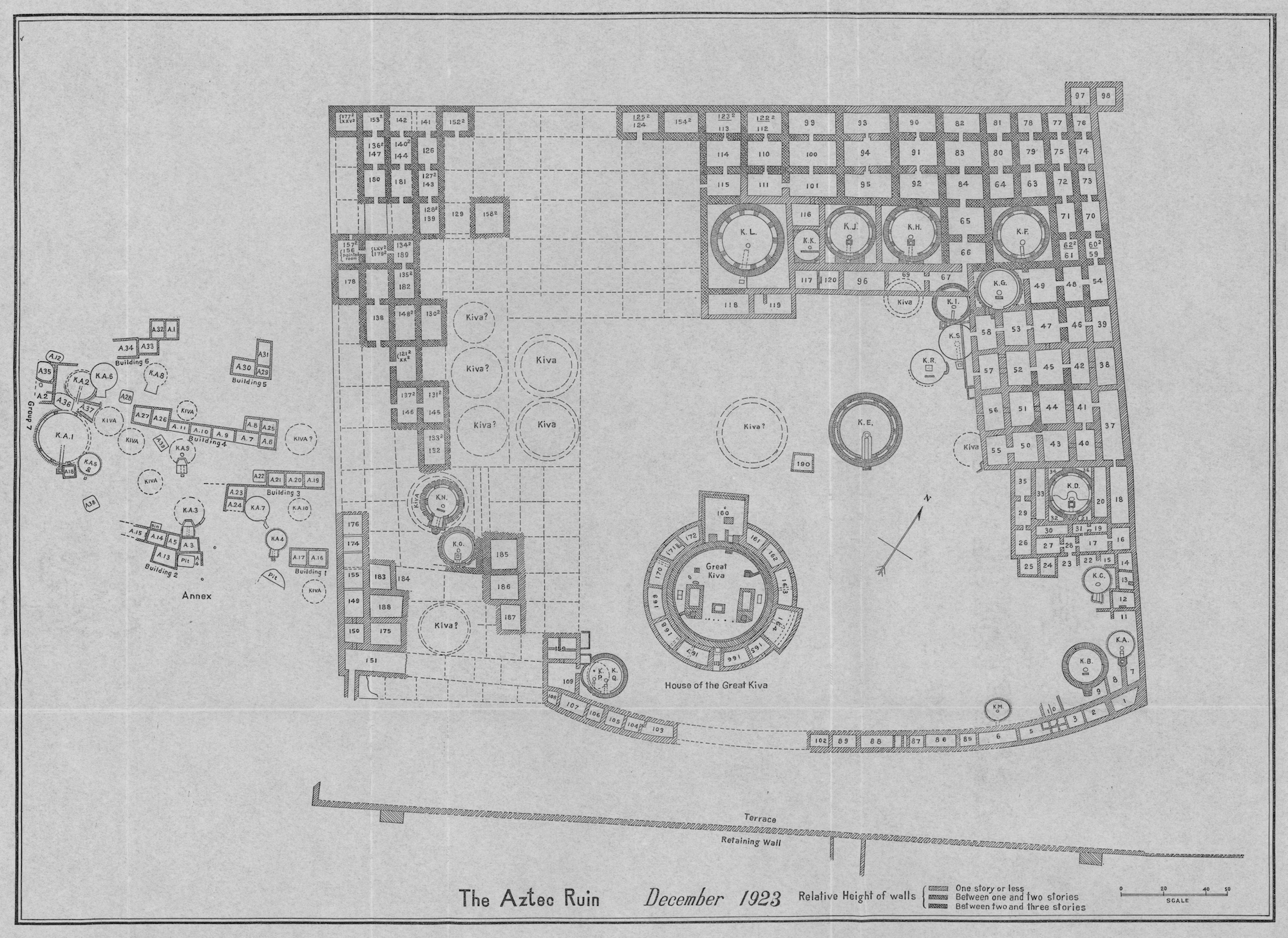
The northern wall of the structure stood three stories tall, although sand drift, stone rubble, and invasive desert brush had overtaken the lower two levels, rendering them subterranean. A large depression in the south end of the courtyard hinted that a Great Kiva lay somewhere beneath the rubble.
For decades, homesteaders and settlers had looted the site for the easy acquisition of cut stone to use in their own building projects. The upper level ceilings, partially weakened by the removal of timbers and water damage, had collapsed. Opportunistic relic hunters, at finding many of the doorways and windows sealed with masonry, broke new entrances through the walls to gain access to rooms in the search for treasures to plunder. And there was evidence that a fire had, at some point, swept through the site.
Likely, with some remorse for his own part played in the looting of the ruin, Earl documented in his field notes, “Unscrupulous curiosity seekers have cut out and carried away many pieces of timber, destroying doorways by tearing out the lintels, and weakening the ceilings by removing the beams. Heedless visitors have inscribed their names in every conceivable place.”6
Damage had been done.
Still, the property had been somewhat protected by the land owner, who made efforts to keep trespassers at bay, and the structure was in relatively good condition when compared with other ruins that had suffered from severe looting and destruction.
The first season was spent clearing the brush away and digging exploratory trenches, before efforts turned in earnest to excavating the dozens of rooms along the east wing before winter set in.
Earl was puzzled. Everything turning up at Aztec was full of contradictions. Refined brick and mortar construction, in the Chaco style found at Chaco Canyon to the south, was found intermingling with a different style of rough construction using cobblestone, more reminiscent of Mesa Verde to the north. Initially, the pottery styles unearthed in the shallow dirt were distinctly Mesa Verdean; beneath them, in older layers of refuse, pottery bore the characteristics of Chaco. Earl found rectangular corner doorways, as those found at Chaco, but also T-shaped doorways in the Mesa Verde style. Sipapus, small holes in the ground symbolizing the portals to the underworld, were present in some kivas, but missing in others.7 Additionally, some of the spaces typically reserved for ceremonial purposes had been repurposed for domestic use, the floors littered with an abundance of cooking pots and every day refuse.
So who were the mysterious people who lived at Aztec?
Initially, Earl concluded that a cultural fusion must have taken place at Aztec. But with each subsequent season of excavation, as the team dug deeper into the ruin, it became clear that there had been two distinct periods of habitation—first by the Chacoans, who were the original builders of the great city, then by the Mesa Verdeans, who moved into the site after it had been abandoned for a century.
During his own years in the field, the chronology of the site had been a puzzle assembled from architecture, pottery styles, burial practices, and stratigraphy. It wasn’t until Dr. A. E. Douglass dated the timber used in the construction of the site, using a new method called dendrochronology8, that solid calendar dates for the construction of Aztec were assigned. This new science of tree-ring dating was astoundingly accurate, though still in its infancy while Earl was excavating, and would supply the final confirmation years after the wheelbarrows and shovels had been hauled away. The dating placed the first major construction phase between 1110 and 1120 CE, the span of only a decade. A second major phase of renovations came a century later in 1252 CE.
The first years of exploration presented an overwhelming mountain of challenges for the young archaeologist, Earl. The excavation work, by nature, exposed the structure to water seepage and new damage. Once the weight of fill was removed from upper-story rooms, many of the rotted floor supports collapsed, tearing out portions of masonry with them. The job became one, not just of excavation, but conservation.
Likely influenced by his own humble beginnings, Earl hired a team of local farmers and residents skilled in carpentry and masonry to help with the work of stabilization. They were not professional archaeologists or excavators, but many had a history just like his own with strong ties to the ruin, and had pothunted or explored them at some point in the past. As each room was revealed, its structural stability was assessed and shored up with fresh concrete, timbers and stone.
The science of Southwest archaeology was still new, and the methods for excavation, documentation, and preservation were still being developed. Earth-moving was laborious and slow. The dirt had packed down over centuries, becoming hard like concrete. Earl had to invent new ways of moving dirt and rubble when his teams’ efforts were falling short. Finding wheelbarrows slow and ineffective, the team erected a temporary tram to be able to move more earth away to a safe location, where it could be sifted through for a second time with brushes and screens. Even the most ordinary, everyday artifacts were preserved as items of value. Earl, assisted at times by his mother, spent hours reconstructing pottery from the many broken pieces recovered.
But not every object coming out of the dirt was ordinary; some finds were exceptional and thrilling. Earl was discovering hidden rooms below rooms—filled with caches of pottery, rare effigies, stone tools, shell ornaments, and turquoise beads. Dozens of skeletons were also being unearthed, along with their funerary goods, many placed in shallow dugouts scooped out from piles of common household trash. Some were not buried at all, and leaned against walls as if asleep.
Earl knew that an understanding of this mysterious culture would come, in large part, from how they treated their dead. He documented the remains of each burial with meticulous detail—the placement and position of the bodies, the wrappings, pots, and accompaniments. Still, there were mysteries that refused to be solved.
Perhaps the most elusive of them all was, where did the people of the Chaco occupation bury their dead? Of the hundreds of burials unearthed at Aztec, only a handful could be positively attributed to the Chaco period of occupation; the remaining were confirmed to be of the Mesa Verde occupation. Even in Chaco Canyon, after hundreds of years of human presence there, only a few burials were found. The funerary goods and treatment of the bodies indicate that those few were of an elite class. Where the commoners were placed would never be revealed to archaeologists.
The architectural discoveries at Aztec were as significant as its burials. Walls emerged from the earth in orderly, geometric layouts. Plastered walls showed traces of murals, hearths appeared beneath layers of household debris, and a growing list of small kivas, some intact and others partially collapsed, surfaced one by one. A Great Kiva of significant size, hinted at by the sunken mound on the southern side of the plaza, slowly resolved into a massive subterranean chamber whose columns, floor features, and altar room Earl documented with characteristic care.9
By the early 1920s, the constraints around Earl’s excavations were tightening. Funding from the American Museum of Natural History was running out. Earl continued for as long as he could, returning for short seasons to finish documentation, stabilize walls, and uncover as many rooms as the remaining funds would permit. But he was frustrated that he would not be able to complete excavation of the ruin in the way that he had originally planned.
In 1923, after six years of intensive excavation and restoration work, the site was designated a National Monument and passed into federal care, and Earl Morris’ work at Aztec drew to a close. He had opened hundreds of rooms, stabilized significant sections of wall, and produced detailed written accounts that remain foundational in the field of Southwestern archaeology. But he did not leave the project feeling finished.
In the decades that followed, he expressed his disappointment with quiet acceptance. In a letter to a colleague in 1940, Earl wrote:
“Once I regarded the Aztec Ruins as a hen might an only chick… The bitter disappointment of having to give up excavation when the venture was, as I planned it, only well begun… have brought me to the point where I view the place impersonally, as I would if I had not devoted in a misguided way some of what should have been the most productive years of my life.”10
And yet Earl’s connection to Aztec was not broken. In 1933, he returned at the National Park Service’s invitation to supervise a new project—to repair and stabilize the Great Kiva. The kiva, excavated years before in 1921, lay open to the sky, filling with water after every rain. Exposure to the elements had exposed the kiva to rapid deterioration and reduced its form to something that was barely recognizable. Earl countered that, to properly return the kiva to a state that would prevent further damage, it should be entirely reconstructed, with a roof added.
Earl painstakingly restored even the smallest of details that he’d documented in his journals, allowing him to remain faithful to the original Chacoan-style of construction.
At the completion of the project, he had accomplished something that was unprecedented in the world of Southwestern archaeology. He rebuilt the kiva to be, as he said, “an example of the most intricate sort of sanctuary that was ever developed by the Pueblo people.”11 Now the public could experience it as a living, breathing space in a way that would have been impossible before.
The Legacy
Earl Morris left Aztec with a record of excavation that shaped every subsequent generation of archaeology in the Southwest. The rooms he cleared, the walls he stabilized, and the meticulous documentation he produced continue to inform both research and preservation. He could not finish the work as he had imagined it, but what he did complete endures. His legacy at Aztec is not simply one of discovery, but of stewardship, humility, and a tireless commitment to preserving the memory of the Pueblo people.
When Earl Morris passed away in 1956 at sixty six years old, his ashes were scattered inside Aztec’s sandstone walls. The exact place has been lost to time, but it seems fitting to imagine that it might be the same room that he first explored with his father sixty years earlier. The man who dedicated his life to learning the secrets of the Ancestral Pueblo would have a final resting place with their ancient spirits.
- Morris, Earl H., “Notes on Excavations in the Aztec Ruin,” Anthropological Papers of the American Museum of Natural History vol. 26, pt. 5 (1928): 393 ↩︎
- Morris, Earl H., 1938 ↩︎
- “Tragedy at Farmington” The Daily Journal (Telluride), December 6, 1904 ↩︎
- Morris, Ann Axtell, Digging in the Southwest, 1933 ↩︎
- Earl H. Morris letter to Clark Wissler, April 30, 1916, Aztec Ruins files, Department of Anthropology Archives, American Museum of Natural History, New York. ↩︎
- Morris, Earl H., “Notes on Excavations in the Aztec Ruin,” The Aztec Ruin. Anthropological Papers of the American Museum of Natural History, vol. 26, pt. 1. New York: AMNH, 1919 ↩︎
- In Pueblan lore, the ancestors came up from the underworld through the sipapu, or “place of emergence,” also known as the symbolic “navel of the earth,” and were granted stewardship over the land and the creatures of the land. The sipapu represented the connection point between the spiritual and the physical world. Despite sharing the same cosmology of the Pueblo people’s origins, the literal expression of the sipapu in kivas was a characteristic adopted by Mesa Verde, but not by Chaco. ↩︎
- Douglass, A. E., Climatic Cycles and Tree-Growth, A Study of the Annual Rings of Trees in Relation to Climate and Solar Activity, 1919 ↩︎
- Morris, Earl H., The House of the Great Kiva at the Aztec Ruin, 1921 ↩︎
- Earl H. Morris letter to Harold S. Gladwin, October 27, 1940 ↩︎
- Earl H. Morris letter to Arno Cammerer, August 12, 1933
Boulder; National Park Service: Aztec Ruins National Monument files at the National Archives, Washington) ↩︎